Google Cloud Platform (GCP) Compute Engine provides virtual machine instances running on Google’s global infrastructure — the same infrastructure that powers Google Search, YouTube, Gmail, and Google’s other services. As one of the three hyperscale cloud providers alongside AWS and Microsoft Azure, Google Cloud Compute offers enterprise-grade compute resources with the unique advantages of Google’s network infrastructure, machine learning capabilities, and data analytics services. For organizations evaluating cloud compute options, Google Cloud represents a platform that combines raw infrastructure power with innovation in areas like Kubernetes (which Google originally created), BigQuery analytics, and AI/ML services.
This review examines Google Cloud Compute Engine’s instance types, pricing models, performance characteristics, global infrastructure, and the broader GCP ecosystem features that influence compute workload decisions. The analysis provides neutral, factual information to help cloud infrastructure evaluators understand what Google Cloud Compute offers and how it compares to alternative cloud compute platforms.
Instance Types and Machine Families
Google Cloud Compute Engine organizes virtual machines into machine families optimized for different workload characteristics. The General-Purpose family (E2, N2, N2D, N1, Tau T2D) provides balanced compute for most workloads. The Compute-Optimized family (C2, C2D, H3) delivers maximum per-core performance for compute-intensive workloads. The Memory-Optimized family (M1, M2, M3) provides high memory-to-CPU ratios for in-memory databases and analytics. The Accelerator-Optimized family (A2, A3, G2) provides GPU-attached instances for machine learning and GPU workloads.
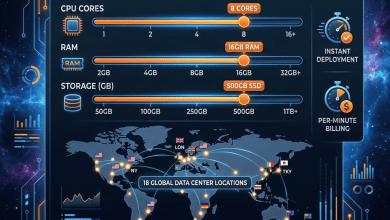
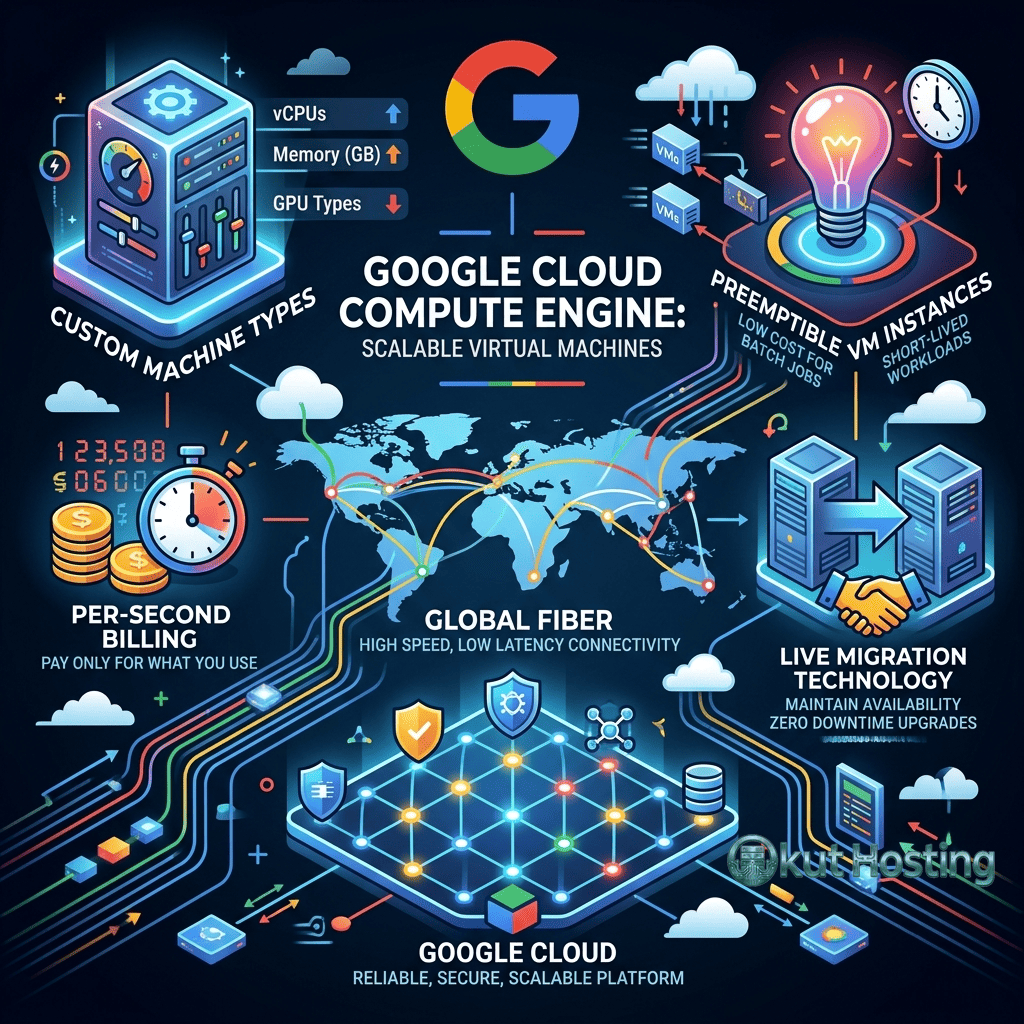
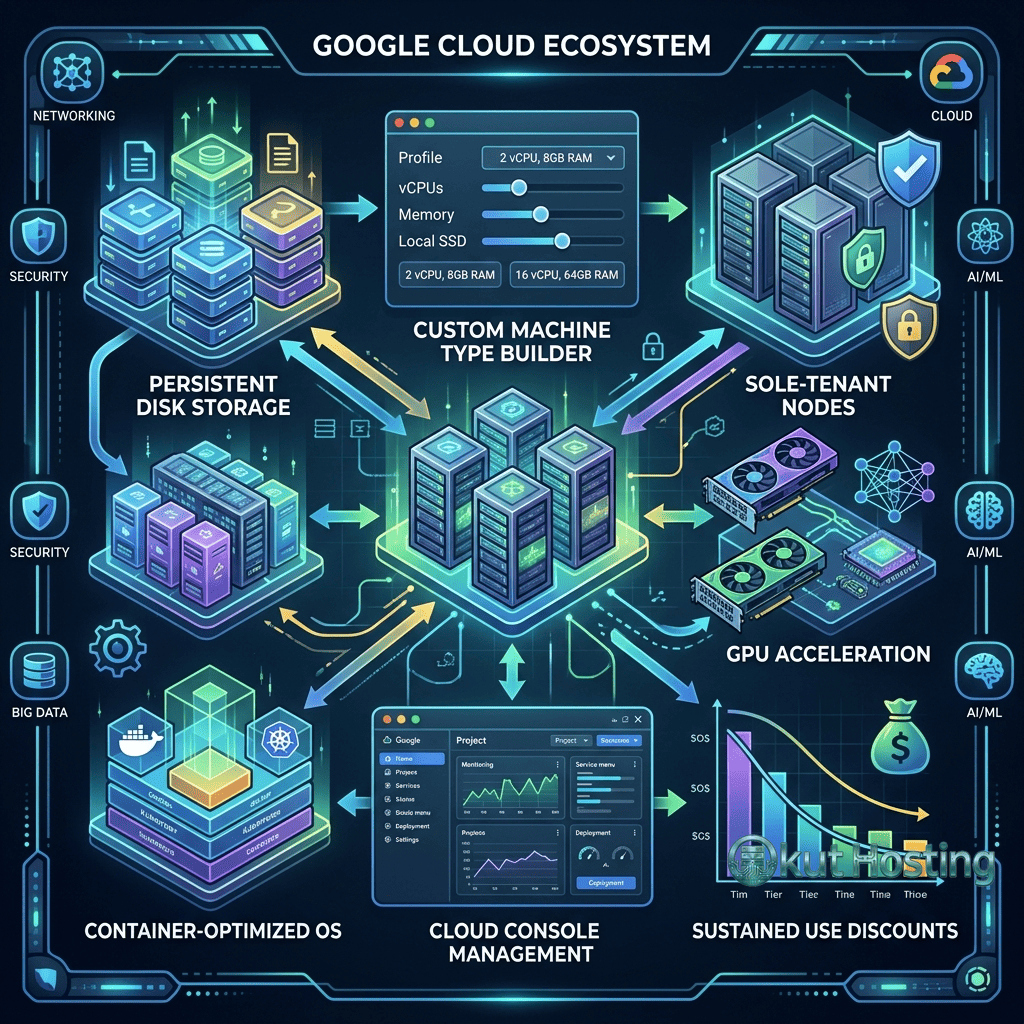
Within each family, instances are available in predefined configurations or custom machine types that allow specifying exact vCPU and memory requirements. Custom machine types are a Google Cloud differentiator — the ability to specify precise resource allocations avoids the over-provisioning that occurs when predefined instance sizes do not match workload requirements exactly. Custom machine types can reduce costs by eliminating wasted resources in instances where predefined sizes would require over-provisioning.
Sole-tenant nodes provide physical server isolation for workloads with compliance, licensing, or performance isolation requirements. Sole-tenant nodes ensure that only the customer’s instances run on the physical server, providing the isolation benefits of dedicated servers within the cloud management framework.
Pricing Models
Google Cloud Compute offers multiple pricing models that accommodate different workload patterns and commitment levels. On-demand pricing provides per-second billing with no commitment, enabling maximum flexibility for variable workloads. Sustained use discounts automatically reduce pricing for instances that run for significant portions of the billing month — no commitment required, the discount applies automatically based on usage patterns.
Committed use discounts (CUDs) provide significant price reductions (up to 57% for compute, up to 70% for memory-optimized) in exchange for one-year or three-year usage commitments. CUDs apply at the project or billing account level, providing flexibility in how committed resources are allocated across instances. Spot VMs (formerly Preemptible VMs) provide up to 91% discount for fault-tolerant workloads that can handle interruption — Spot VMs can be reclaimed by Google with 30 seconds notice when capacity is needed.
The sustained use discount mechanism is a unique Google Cloud advantage — no other hyperscale provider automatically reduces pricing based on usage without requiring explicit commitment purchases. This automatic discount provides cost savings for workloads with consistent usage patterns without the financial commitment of reserved instances.
Global Infrastructure
Google Cloud operates data centers across multiple regions worldwide, including locations in North America, South America, Europe, Asia-Pacific, Middle East, and Africa. Each region contains multiple zones (independent failure domains) that support high-availability deployments. The global network connects regions through Google’s private fiber network — one of the largest private networks in the world — providing low-latency inter-region connectivity.
Google’s Premium Tier networking routes traffic through Google’s private network rather than the public internet, providing lower latency and higher throughput for workloads that benefit from network quality. Standard Tier networking provides cost-effective connectivity through public internet routing for workloads where network quality is less critical. The choice between Premium and Standard tier networking enables balancing network performance against cost.
Google Kubernetes Engine
Google Kubernetes Engine (GKE) provides managed Kubernetes clusters for containerized workload orchestration. As the creator of Kubernetes, Google brings unique expertise to managed Kubernetes services. GKE handles cluster management, control plane operations, automatic upgrades, node auto-provisioning, and integration with Google Cloud’s monitoring and logging services. GKE Autopilot mode further simplifies Kubernetes by managing the nodes automatically, billing only for the resources consumed by deployed pods.
GKE’s maturity and feature depth make it arguably the most capable managed Kubernetes service among the major cloud providers. Features like Binary Authorization for container image verification, Workload Identity for secure service account management, and Config Connector for managing Google Cloud resources through Kubernetes APIs demonstrate the depth of GKE’s Kubernetes integration.
Storage Services
Persistent Disk provides block storage for Compute Engine instances in Standard (HDD), Balanced (SSD), Performance (SSD), and Extreme (SSD) tiers. Local SSD provides ephemeral, physically attached NVMe storage for workloads requiring the lowest latency storage I/O. Cloud Storage provides object storage with multiple storage classes (Standard, Nearline, Coldline, Archive) for different access frequency requirements.
Filestore provides managed NFS file storage for workloads requiring shared file system access across multiple instances. The storage portfolio covers the full range of storage requirements from high-performance NVMe to cost-effective archival storage, enabling optimized storage cost-performance for diverse workload types.
Networking and Security
Virtual Private Cloud (VPC) networking provides isolated network environments with fine-grained firewall rules, private Google Access for accessing Google services without public IP addresses, and Cloud NAT for secure outbound internet access. Cloud Load Balancing provides global and regional load balancing with HTTP/HTTPS, TCP/SSL, and UDP support. Cloud CDN accelerates content delivery through Google’s edge network.
Cloud Armor provides DDoS protection and web application firewall capabilities. Identity-Aware Proxy (IAP) provides context-aware access control for applications without VPN. Cloud HSM provides hardware security module services for cryptographic key management. The security service portfolio reflects Google Cloud’s enterprise focus and compliance capabilities.
Identity and Access Management
Google Cloud IAM provides granular access control for managing who has access to specific resources and what actions they can perform. IAM policies support role-based access control with predefined roles for common access patterns and custom roles for organization-specific requirements. Service accounts provide identity for applications and services, enabling secure authentication between Google Cloud services without user credentials. Organization policies enforce compliance requirements across projects and folders within the organizational hierarchy.
Cloud Run and Serverless
Cloud Run provides serverless container hosting that scales automatically from zero to thousands of instances based on incoming traffic. Cloud Run eliminates the need for managing server infrastructure while supporting any containerized application that listens on HTTP requests. The serverless model means users pay only for the resources consumed during request processing, with no charges for idle time. Cloud Functions provides event-driven serverless computing for lightweight functions triggered by events from Google Cloud services, HTTP requests, or scheduled timers.
For organizations transitioning from traditional server-based hosting to cloud-native architectures, Cloud Run provides a bridge between containerized applications and fully serverless deployment. Applications packaged as Docker containers can be deployed to Cloud Run without modification, providing the scalability and cost benefits of serverless infrastructure without requiring application architecture changes.
Data Analytics Ecosystem
BigQuery provides serverless, petabyte-scale data warehouse and analytics capabilities. Dataflow provides managed data processing for both batch and streaming workloads. Dataproc provides managed Spark and Hadoop clusters for large-scale data processing. Pub/Sub provides real-time messaging for event-driven architectures. This data analytics ecosystem differentiates Google Cloud from other providers, providing integrated analytics capabilities that complement compute infrastructure for data-intensive organizations.
For organizations that combine web hosting with data analytics, Google Cloud’s integrated platform enables running web applications on Compute Engine or GKE while leveraging BigQuery for analytics, Cloud Storage for data lakes, and Vertex AI for machine learning — all within the same platform with unified networking, security, and billing.
WordPress and Web Hosting on Google Cloud
WordPress hosting on Google Cloud Compute Engine provides enterprise-grade performance with full server control. Google Cloud Marketplace provides one-click WordPress deployment on Compute Engine instances with optimized configurations. The Click to Deploy WordPress solution includes Apache, MySQL, and PHP with automatic configuration. For higher performance, custom LEMP stack deployments with Nginx and PHP-FPM provide optimized WordPress hosting with server-level caching.
Cloud CDN integration accelerates WordPress content delivery through Google’s global edge network. Cloud SQL provides managed MySQL databases that simplify database management for WordPress deployments. Cloud Storage can serve WordPress media files directly, reducing storage load on Compute Engine instances. This integrated architecture provides enterprise WordPress hosting with the reliability and global performance of Google’s infrastructure.
Migration Services
Migrate to Virtual Machines (Migrate to VM) provides automated migration of virtual machines from on-premises environments, AWS, or Azure to Google Cloud Compute Engine. The migration service handles VM conversion, testing, and cutover with minimal downtime. Database Migration Service provides managed migration for MySQL, PostgreSQL, and SQL Server databases. These migration services reduce the complexity and risk of moving workloads to Google Cloud from existing infrastructure.
Compliance and Certifications
Google Cloud maintains extensive compliance certifications including SOC 1/2/3, ISO 27001/27017/27018, PCI DSS, HIPAA, FedRAMP, and regional certifications for specific geographic jurisdictions. The compliance portfolio supports regulated workloads across industries including healthcare, financial services, government, and education. Assured Workloads provides additional compliance controls for specific regulatory frameworks, enabling workload placement in compliant environments with organizational policy enforcement.
Developer Tools and Infrastructure as Code
Google Cloud provides comprehensive developer tools including Cloud SDK (gcloud CLI), Cloud Shell (browser-based command-line environment), Cloud Build (CI/CD service), Artifact Registry (container and package management), and Source Repositories. Terraform support enables Infrastructure as Code management for all Google Cloud resources. Deployment Manager provides Google Cloud-native infrastructure templating. The developer tool ecosystem supports modern development workflows from code development through deployment and monitoring.
Machine Learning and AI Services
Google Cloud’s AI and machine learning services represent a significant differentiator for organizations leveraging compute infrastructure for AI/ML workloads. Vertex AI provides a unified platform for building, deploying, and managing machine learning models. Pre-trained APIs provide vision, speech, language, and translation capabilities without custom model development. TPU (Tensor Processing Unit) instances provide Google’s custom AI accelerator hardware for training and inference of large-scale machine learning models.
Monitoring and Operations
Cloud Monitoring (formerly Stackdriver) provides comprehensive metrics, dashboards, and alerting for Compute Engine instances and other Google Cloud services. Cloud Logging provides centralized log management and analysis. Cloud Trace provides distributed tracing for application performance analysis. The operations suite provides integrated observability that covers metrics, logs, traces, and profiling in a unified platform.
Support Plans
Google Cloud offers tiered support plans: Basic (free, community and documentation only), Standard (paid, business hours response), Enhanced (paid, faster response with 24/7 critical issue support), and Premium (dedicated Technical Account Manager with fastest response times). The Premium support plan includes proactive infrastructure reviews, training credits, and direct access to Google Cloud engineering expertise. For enterprise deployments, Premium support provides the responsive, expert assistance needed for production-critical workloads.
Billing and Cost Management
Google Cloud provides comprehensive billing management tools including billing accounts, budgets and alerts, cost breakdowns by project and service, billing export to BigQuery for custom cost analysis, and recommendations for cost optimization. The Recommender service provides automated suggestions for rightsizing instances, identifying idle resources, and optimizing committed use discount coverage. These cost management tools help organizations maintain visibility into cloud spending and identify optimization opportunities proactively.
Anthos and Hybrid Cloud
Anthos provides a hybrid and multi-cloud platform that extends Google Cloud services to on-premises environments, AWS, and Azure. Anthos enables running Kubernetes workloads across multiple environments with consistent management, security, and policy enforcement. For organizations with hybrid infrastructure requirements, Anthos provides a unified management layer that bridges cloud and on-premises environments. This hybrid capability is increasingly important for enterprises that need to maintain some workloads on-premises while leveraging cloud capabilities for others.
Anthos Service Mesh provides managed service mesh capabilities for microservice communication, security, and observability across hybrid and multi-cloud environments. Config Management provides policy-as-code enforcement across all Anthos-managed clusters. These enterprise features position Google Cloud as a comprehensive platform for complex, multi-environment infrastructure architectures that extend beyond traditional single-cloud deployments.
Comparison with AWS and Azure
Google Cloud Compute competes with AWS EC2 and Azure Virtual Machines as the three hyperscale cloud compute platforms. Google Cloud differentiates through sustained use discounts (automatic, no commitment required), custom machine types (precise resource specification), Google’s private network (Premium Tier networking), Kubernetes expertise (GKE as the most mature managed Kubernetes), and AI/ML capabilities (Vertex AI, TPUs). AWS differentiates through the broadest service portfolio and largest market share. Azure differentiates through Microsoft enterprise integration and hybrid cloud capabilities.
For organizations choosing between hyperscale providers, the decision often involves existing technology investments, team expertise, specific service requirements, and enterprise relationship considerations rather than pure compute performance or pricing comparisons. Each hyperscale provider offers comparable core compute capabilities with differentiation in adjacent services and ecosystem features.
Pricing Comparison with Independent Providers
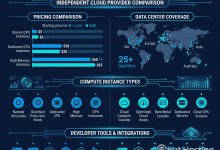
Google Cloud Compute pricing is generally higher than independent cloud providers (DigitalOcean, Linode, Vultr) for equivalent compute resources, reflecting the additional value of Google’s managed services, enterprise features, and global infrastructure. However, committed use discounts and sustained use discounts can narrow the pricing gap significantly for predictable workloads. For organizations that need only basic cloud compute without enterprise managed services, independent providers often provide better value. For organizations leveraging managed databases, Kubernetes, AI/ML services, and enterprise security features, Google Cloud’s integrated platform may justify the premium pricing.
Free Tier and Credits
Google Cloud provides a free tier that includes Always Free products (limited compute, storage, and networking resources available indefinitely) and a $300 credit for new accounts valid for 90 days. The free tier enables evaluating Google Cloud services without financial commitment. The Always Free tier includes a small Compute Engine instance, Cloud Storage, BigQuery queries, and other services at limited usage levels.
Summary
Google Cloud Compute Engine provides enterprise-grade cloud compute infrastructure backed by Google’s private global fiber network and extensive managed service ecosystem. The platform’s key differentiators — automatic sustained use discounts, flexible custom machine types, industry-leading GKE Kubernetes excellence, Premium Tier networking performance, and powerful AI/ML capabilities — position Google Cloud as a compelling choice for organizations that value network performance, Kubernetes maturity, and machine learning integration. While pricing is higher than independent cloud providers for basic compute, the integrated platform value and automatic discount mechanisms make Google Cloud competitive for organizations leveraging the broader service ecosystem.
For cloud compute evaluators, Google Cloud Compute merits consideration alongside AWS and Azure for enterprise workloads, and alongside independent providers for workloads where specific Google Cloud capabilities (GKE, BigQuery, Vertex AI) provide unique value that independent platforms cannot match.
Features, pricing, and availability discussed in this review reflect information available at the time of writing. Please verify current details on the official Google Cloud website. Okut Hosting is an independent review platform with no affiliate relationships with any hosting company mentioned in this article.
For related reviews, see our AWS Lightsail review, our Microsoft Azure VMs review, and our guide to cloud server scaling.