Kamatera distinguishes itself in the cloud hosting market through exceptionally granular server customization capabilities that enable configuring virtual machines with precise resource specifications. Founded in 1995, Kamatera operates enterprise-grade data centers across four continents and provides cloud infrastructure designed for organizations that need exact control over server configurations rather than selecting from predefined plan sizes. This approach to cloud computing — where CPU cores, memory, storage, and network resources are individually configurable — provides cost optimization opportunities that fixed-plan providers cannot match.
This review examines Kamatera’s cloud VPS platform in detail, covering the customizable server configuration system, global data center coverage, pricing models, managed services, enterprise features, and the specific advantages of Kamatera’s flexible infrastructure approach. The analysis provides neutral, factual evaluation to help hosting buyers determine whether Kamatera’s granular customization approach aligns with their infrastructure requirements.
Customizable Server Configurations
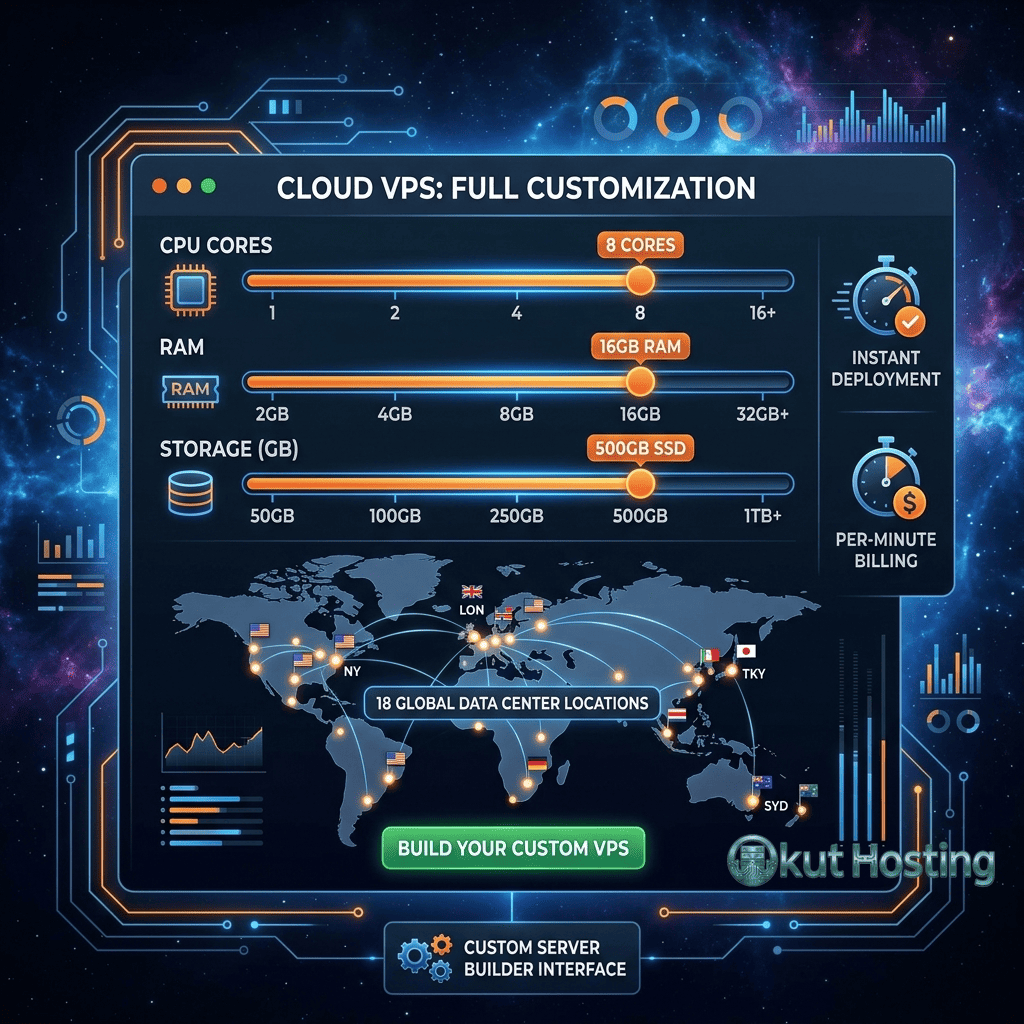
Kamatera’s defining feature is its server configuration flexibility. When creating a cloud server, users specify exact values for CPU cores (from 1 to 104 cores), RAM (from 256 MB to 512 GB), SSD storage (from 20 GB to 4 TB), and network bandwidth. This à la carte configuration model eliminates the constraint of fixed-plan pricing where users must select predefined configurations that may not match their exact workload requirements. The granular configuration capability means users pay only for the resources they need, avoiding the over-provisioning waste that occurs when fixed plans exceed actual requirements.
The configuration flexibility extends to processor type selection. Users can choose between different CPU types — including availability type A (general purpose), type B (dedicated), and type T (burstable) — providing additional control over performance characteristics and pricing. This processor type selection is uncommon among cloud providers and enables optimizing the performance-cost balance for specific workload patterns.
Server configurations can be modified after creation, enabling vertical scaling without server replacement. CPU cores, memory, and storage can be increased or decreased to match changing workload demands. This live reconfiguration capability supports dynamic resource management for applications with varying resource requirements across different operational periods.
Global Data Center Network
Kamatera operates data centers across North America (New York, Dallas, Santa Clara), Europe (London, Amsterdam, Frankfurt), Middle East (Tel Aviv, Jerusalem, Haifa, Rosh HaAyin), and Asia-Pacific (Hong Kong, Tokyo). The data center coverage spans major business regions with particularly strong Middle East representation, reflecting Kamatera’s Israeli heritage and the company’s strategic positioning for organizations needing infrastructure in the Middle East region.
Each data center provides the full range of Kamatera services and configuration options. The multi-continent coverage enables deploying applications close to target audiences across major global regions. For organizations with Middle Eastern audience requirements, Kamatera provides data center options that many competing cloud providers do not offer in that geographic area.
Pricing Model
Kamatera implements hourly billing with monthly usage aggregation. The per-resource pricing model charges separately for CPU, memory, storage, and bandwidth, with the total server cost calculated as the sum of individual resource costs. This component-based pricing provides cost transparency — users can see exactly how each resource contributes to the total cost and optimize configurations accordingly.
The pricing competitiveness varies by configuration. For some resource combinations, Kamatera’s pricing is very competitive with DigitalOcean, Linode, and Vultr. For other combinations, the component-based pricing may result in higher total costs than equivalent fixed-plan offerings. The key advantage is the ability to precisely match resources to requirements, which can reduce total cost by eliminating resource waste even when per-unit resource pricing is not the absolute lowest available.
A 30-day free trial provides new users with cloud server access for evaluation without financial commitment. The trial enables testing server performance, management interface, and API capabilities before committing to paid usage.
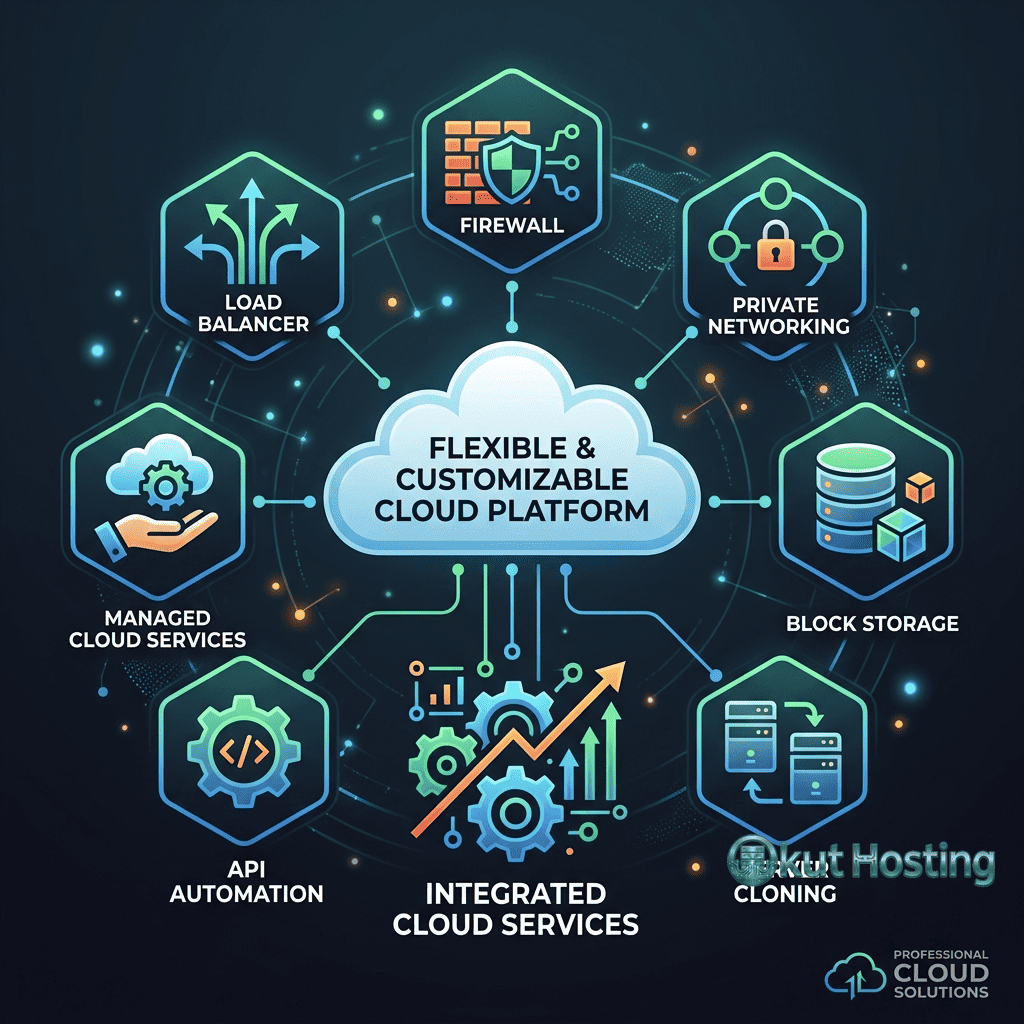
Cloud Firewall
Kamatera Cloud Firewall provides network-level access control for cloud servers. Firewall rules define permitted inbound and outbound traffic based on IP addresses, ports, and protocols. The firewall is configurable through the management console and API. For enterprise deployments, firewall rules can be applied consistently across multiple servers through firewall templates, ensuring security policy uniformity across the infrastructure.
Cloud Load Balancer
Kamatera Cloud Load Balancer distributes incoming traffic across multiple cloud servers for high availability and performance. Load balancers support HTTP/HTTPS and TCP protocols with configurable health checks, session persistence, and SSL termination. The load balancer service integrates with Kamatera’s cloud servers and private networks, enabling load-balanced architectures within isolated network environments.
Private Networks
Private cloud networks enable isolated communication between Kamatera servers within the same data center. Private networks provide secure, low-latency connectivity between servers without traffic traversing the public internet. Multi-tier application architectures with separate web, application, and database servers benefit from private network isolation that enhances both security and performance.
Block Storage
Kamatera Block Storage provides additional persistent storage volumes that can be attached to cloud servers. Block storage volumes support configurable sizes and can be moved between servers within the same data center. The block storage service supplements the primary server storage, providing flexible storage expansion for applications that require more storage capacity than the server’s primary disk provides.
DNS Management
Kamatera provides DNS hosting and management services for domain name resolution. DNS management through the Kamatera console enables configuring A, AAAA, CNAME, MX, TXT, NS, and SRV records. The DNS service provides reliable domain resolution with redundant nameservers. For organizations consolidating infrastructure management, Kamatera’s integrated DNS eliminates the need for separate DNS hosting providers while maintaining DNS management alongside server infrastructure.
Cloud Monitoring
Kamatera monitoring services provide real-time visibility into server performance metrics including CPU utilization, memory usage, disk I/O, and network throughput. Monitoring dashboards display current and historical performance data, enabling capacity planning and performance trend analysis. Alert configurations notify administrators when performance metrics exceed defined thresholds, enabling proactive response to potential issues before they impact application performance or availability.
The monitoring integration with managed services enables Kamatera’s technical team to proactively address performance issues for managed customers. For unmanaged servers, the monitoring data provides the visibility needed for self-managed performance optimization and capacity planning decisions.
Windows Server Support
Kamatera provides Windows Server VPS with multiple Windows Server editions including Windows Server 2019 and 2022. Windows licensing is included in the server pricing for Windows configurations. Remote Desktop Protocol (RDP) access enables graphical Windows server management. The Windows server support extends Kamatera’s platform to workloads that require Windows-specific technologies including ASP.NET, IIS, MSSQL, and Windows-based enterprise applications.
CDN Integration
Content delivery acceleration through CDN integration enables caching and distributing static content closer to end users globally. CDN services reduce latency for geographically distributed audiences by serving cached content from edge locations rather than the origin server. For websites and applications hosted on Kamatera servers, CDN integration improves page load performance for visitors accessing content from regions distant from the hosting data center.
Object Storage
Kamatera provides S3-compatible object storage for scalable, unstructured data storage. Object storage serves backup repositories, media file hosting, static website assets, and application data storage. The S3 API compatibility ensures that standard tools and applications designed for Amazon S3 work seamlessly with Kamatera object storage, simplifying integration with existing workflows and applications that already use S3-compatible storage interfaces.
Management Console Experience
The Kamatera management console provides web-based access to all cloud infrastructure management functions. The console interface supports server management, network configuration, storage management, DNS administration, and billing oversight through a unified dashboard. The server creation workflow prominently features the resource configuration sliders that enable specifying exact CPU, memory, and storage values — the visual representation of Kamatera’s configuration flexibility. Console usability is functional and capable, though the interface design is less polished than the management consoles of developer-focused providers like DigitalOcean.
Disaster Recovery
Kamatera’s multi-region data center presence enables implementing disaster recovery architectures that replicate critical workloads across geographically separated data centers. Server snapshots can be used to create standby instances in alternate regions for failover during data center-level disruptions. Combined with DNS failover capabilities, multi-region deployment provides business continuity protection against regional infrastructure failures. The configuration flexibility extends to disaster recovery — standby instances can be configured with reduced resources during standby mode and scaled to full production specifications during failover activation.
Enterprise VPN
Kamatera VPN services enable secure, encrypted connectivity between on-premises networks and Kamatera cloud infrastructure. VPN connectivity supports site-to-site configurations for hybrid architectures that combine cloud and on-premises resources. For organizations migrating workloads progressively from on-premises to cloud, VPN connectivity enables secure communication between existing infrastructure and new cloud deployments during the transition period.
Managed Cloud Services
Kamatera offers managed cloud services where Kamatera’s technical team handles server administration, security hardening, monitoring, and maintenance. The managed service option transforms Kamatera from an infrastructure provider into a full-service hosting platform, suitable for organizations that need cloud infrastructure without dedicated system administration staff. Managed services include operating system updates, security patching, performance monitoring, and 24/7 infrastructure management.
The availability of managed services alongside unmanaged infrastructure provides flexibility that many cloud providers do not offer. Organizations can deploy some servers with managed support for production-critical workloads while using unmanaged servers for development and testing environments where managed support is unnecessary.
Server Images and Templates
Kamatera provides a comprehensive library of server images including major Linux distributions (Ubuntu, Debian, CentOS, Rocky Linux, AlmaLinux), Windows Server editions, and application-specific images. Application images include pre-configured stacks for cPanel, Plesk, WordPress, LAMP, Docker, and development frameworks. Custom server images can be created from existing servers, enabling environment replication and standardized deployment templates.
WordPress Hosting on Kamatera
WordPress hosting on Kamatera benefits from the platform’s configuration flexibility. WordPress deployments can be configured with optimized resource allocations — adequate CPU for PHP processing, generous memory for MySQL buffer pool and OPcache, and fast SSD storage for database I/O. The ability to precisely configure resources means WordPress sites can be hosted on servers sized exactly for their traffic patterns and content complexity, avoiding both resource waste and resource constraints.
For WordPress agencies managing diverse client portfolios, Kamatera’s customizable configurations enable creating differently-sized servers for different client requirements. High-traffic e-commerce sites receive generous CPU and memory allocations while small informational sites use minimal, cost-effective configurations. This flexibility optimizes total hosting expenditure across a portfolio of diverse WordPress deployments.
API and Automation
Kamatera’s REST API provides programmatic access to all cloud management functions including server creation, configuration, scaling, and deletion. The API enables automating infrastructure provisioning, implementing auto-scaling workflows, and integrating Kamatera infrastructure with existing DevOps toolchains. Terraform provider support enables Infrastructure as Code management for Kamatera resources.
Migration to Kamatera
Migrating workloads to Kamatera from other hosting providers follows standard server migration procedures including file transfer, database migration, application configuration, and DNS reconfiguration. The platform’s configuration flexibility enables creating target servers with exact resource specifications that match the source workload requirements. The 30-day free trial enables testing migration procedures and validating application performance on Kamatera infrastructure before committing to full production migration.
Service Level Agreement
Kamatera provides a 99.95% uptime SLA for cloud server infrastructure with service credits for downtime that exceeds the guaranteed level. The SLA commitment applies to server availability and network connectivity. The uptime guarantee is competitive with industry standards and provides financial protection against infrastructure availability failures. For workloads requiring higher availability, multi-server architectures with load balancing across multiple Kamatera servers or data centers provide additional availability beyond the single-server SLA guarantee.
Use Case Profiles
Kamatera is particularly well-suited for several specific use case profiles. Enterprise applications requiring precise resource allocation benefit from the granular configuration system that eliminates over-provisioning waste. Development and testing environments benefit from the ability to create diverse server configurations matching different application requirements. Agencies and hosting resellers benefit from the flexibility to create custom-sized servers for each client’s specific requirements.
Organizations with Middle East audience requirements benefit from Kamatera’s extensive Israeli data center presence that provides low-latency hosting options unavailable from most competing cloud providers. SaaS applications with predictable resource requirements benefit from precise configuration that optimizes cost without sacrificing performance. E-commerce platforms benefit from the ability to scale server resources during promotional periods and reduce them during normal operations.
Competitive Positioning
Kamatera competes with DigitalOcean, Linode, Vultr, and other independent cloud providers with differentiation through configuration flexibility, Middle East data center presence, and optional managed services. While competitors offer broader managed service portfolios and larger developer communities, Kamatera’s configuration granularity provides unique value for organizations where resource precision matters more than ecosystem breadth. The combination of customizable infrastructure with available managed services positions Kamatera as a versatile platform that accommodates both self-managed and managed hosting requirements within a single provider relationship.
Security and Compliance
Kamatera data centers maintain ISO 27001 certification and implement physical security controls including biometric access, surveillance, and security personnel. Network infrastructure includes DDoS mitigation, intrusion detection, and redundant connectivity. The security implementation covers enterprise requirements for infrastructure security, though specific compliance certifications beyond ISO 27001 may be more limited than those offered by hyperscale providers.
Customer Support
Kamatera provides 24/7 customer support through phone, email, and live chat. The support team handles platform-specific issues, server provisioning assistance, and billing inquiries. For managed service customers, the support scope extends to server administration, security management, and performance optimization. The multi-channel support availability ensures responsive assistance across communication preferences and time zones.
Backup and Recovery
Automated backup services provide scheduled server snapshots with configurable retention periods. Backup copies enable point-in-time recovery, migration, and disaster recovery. The backup service is available as an add-on with pricing based on backup storage consumption. For production workloads, implementing both Kamatera backups and off-platform backup replication provides comprehensive data protection against both server-level and infrastructure-level failures.
Limitations
- Brand recognition: Kamatera is less well-known than DigitalOcean, Linode, and Vultr, which may affect community support and third-party integration availability.
- Managed services pricing: Managed services add significant cost to the infrastructure pricing, which may make total cost less competitive than managed hosting alternatives.
- Marketplace: The application image library is less extensive than those offered by larger platforms.
- Documentation: Documentation depth is less comprehensive than market leaders, potentially increasing setup complexity for new users.
Summary
Kamatera Cloud VPS provides exceptionally flexible server configuration capabilities that enable precise resource allocation for diverse workload requirements. The component-based pricing model, global data center coverage including unique Middle East locations, and optional managed services create a versatile cloud platform suitable for organizations that value configuration precision and resource optimization. For hosting buyers who need exact control over server specifications, Kamatera’s granular customization approach provides capabilities that fixed-plan providers cannot match.
The platform is particularly well-suited for agencies managing diverse hosting portfolios, organizations needing Middle East data center locations, enterprises requiring managed cloud services with customizable infrastructure, and technically capable users who want maximum control over server resource allocation and pricing optimization.
Features, pricing, and availability discussed in this review reflect information available at the time of writing. Please verify current details on the official Kamatera website. Okut Hosting is an independent review platform with no affiliate relationships with any hosting company mentioned in this article.
For related reviews, see our Vultr VPS review, our UpCloud review, and our guide to managed vs unmanaged VPS.