Vultr has established itself as a significant player in the independent cloud computing market since its founding in 2014, providing cloud infrastructure across one of the largest independent data center networks in the industry. With data centers spanning six continents and over 30 locations worldwide, Vultr offers geographic coverage that rivals the hyperscale cloud providers while maintaining the simplicity and transparent pricing that characterize the best independent cloud platforms. The company serves a diverse customer base from individual developers to enterprise organizations, all attracted by Vultr’s combination of performance, pricing, and global reach.
This review examines Vultr’s cloud computing platform in detail, covering the complete product portfolio, pricing structure, performance characteristics, developer tools, and infrastructure capabilities. The analysis evaluates Vultr’s strengths and limitations to help potential users determine whether the platform aligns with their cloud infrastructure requirements and technical preferences.
Product Portfolio
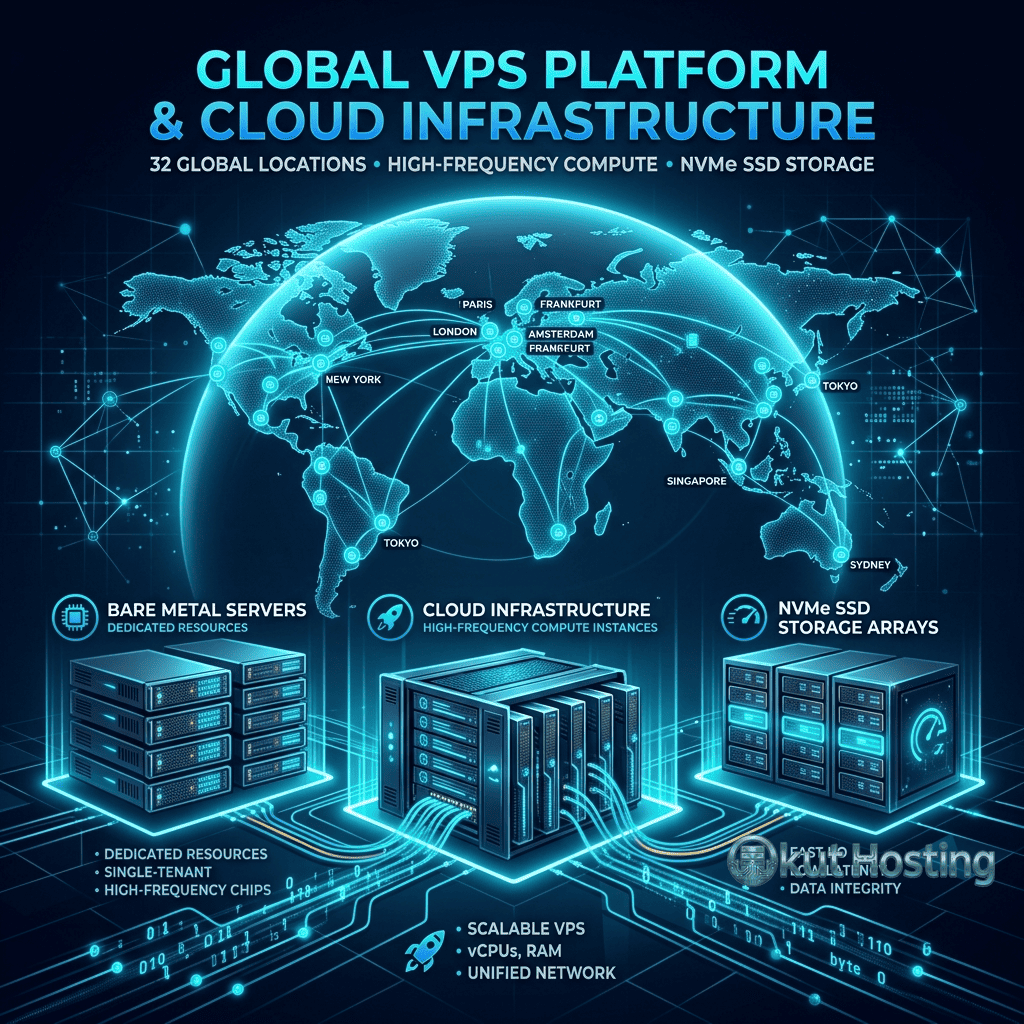
Vultr’s product lineup extends well beyond basic VPS hosting, encompassing multiple compute categories designed for different workload requirements. The platform offers Cloud Compute (shared and dedicated vCPU instances), High Frequency Compute (premium performance instances), Bare Metal servers, Managed Databases, Kubernetes Engine, Block Storage, Object Storage, Load Balancers, and networking services. This comprehensive portfolio positions Vultr as a full-service cloud infrastructure provider rather than a simple VPS host.
Cloud Compute Plans
Vultr’s Cloud Compute instances are available in Regular Performance (shared vCPU) and High Performance (dedicated vCPU with NVMe storage) tiers. Regular Performance instances provide cost-effective compute for development, testing, and low-traffic production workloads. High Performance instances deliver consistent processing power with NVMe SSD storage for I/O-intensive applications, databases, and high-traffic websites.
Instance sizes scale from entry-level configurations suitable for small applications to large instances with significant CPU, memory, and storage allocations. The granular sizing options enable right-sizing instances to match workload requirements closely, avoiding the over-provisioning costs that result from choosing the next larger plan when smaller options are available.
High Frequency Compute
High Frequency Compute instances use the latest generation processors (high clock speed CPUs) with NVMe storage to deliver maximum single-thread performance. These instances are optimized for workloads where single-core performance matters more than core count — including WordPress hosting, e-commerce platforms, real-time applications, and database servers that benefit from high clock speeds rather than parallel processing.
Bare Metal Servers
Vultr’s Bare Metal offerings provide dedicated physical servers without virtualization overhead. Bare Metal instances deliver the full performance of the underlying hardware with single-tenant isolation, making them suitable for performance-critical workloads, compliance-sensitive applications, and workloads that require direct hardware access. Bare Metal servers are available in multiple configurations with varying CPU, memory, and storage specifications.
Pricing Structure
Vultr implements hourly billing with monthly caps — instances are billed by the hour but never exceed the monthly price. This pricing model provides flexibility for short-term workloads while ensuring cost predictability for long-running instances. Pricing is transparent and publicly listed, enabling accurate cost projections without complex pricing calculators.
Vultr’s entry-level pricing is competitive, with the smallest instances available at some of the lowest prices in the independent cloud market. This aggressive entry-level pricing makes Vultr particularly attractive for developers, students, and small projects that need cloud infrastructure at minimal cost. As instances scale up, pricing remains competitive with DigitalOcean and Linode, with specific price advantages varying by instance category and configuration.
Transfer allowances are included with each instance, with generous monthly allocations that exceed most workload requirements. Bandwidth pooling across instances within the same account enables flexible bandwidth distribution. Overage pricing applies when transfer allowances are exceeded.
Global Data Center Network
Vultr’s most compelling infrastructure advantage is its extensive global data center network, spanning over 30 locations across six continents. Data center locations include multiple US cities, Toronto, Mexico City, São Paulo, London, Amsterdam, Paris, Frankfurt, Madrid, Stockholm, Warsaw, Mumbai, Delhi, Bangalore, Seoul, Tokyo, Singapore, Melbourne, Sydney, Johannesburg, and additional locations. This geographic diversity is unmatched among independent cloud providers and approaches the coverage of hyperscale providers.
The extensive data center network enables deploying workloads close to virtually any audience worldwide. Latency-sensitive applications benefit from geographic proximity to end users, and the wide location selection supports compliance requirements for data sovereignty and geographic data residency. Users can deploy instances across multiple regions for geographic redundancy and disaster recovery configurations.
Managed Services
Vultr Managed Databases provide fully managed database hosting for MySQL, PostgreSQL, Redis, Kafka, and other database engines. Managed databases handle provisioning, configuration, patching, backups, and scaling, reducing the operational burden of database management. The managed database service supports high availability configurations with automatic failover for production workloads that require database resilience.
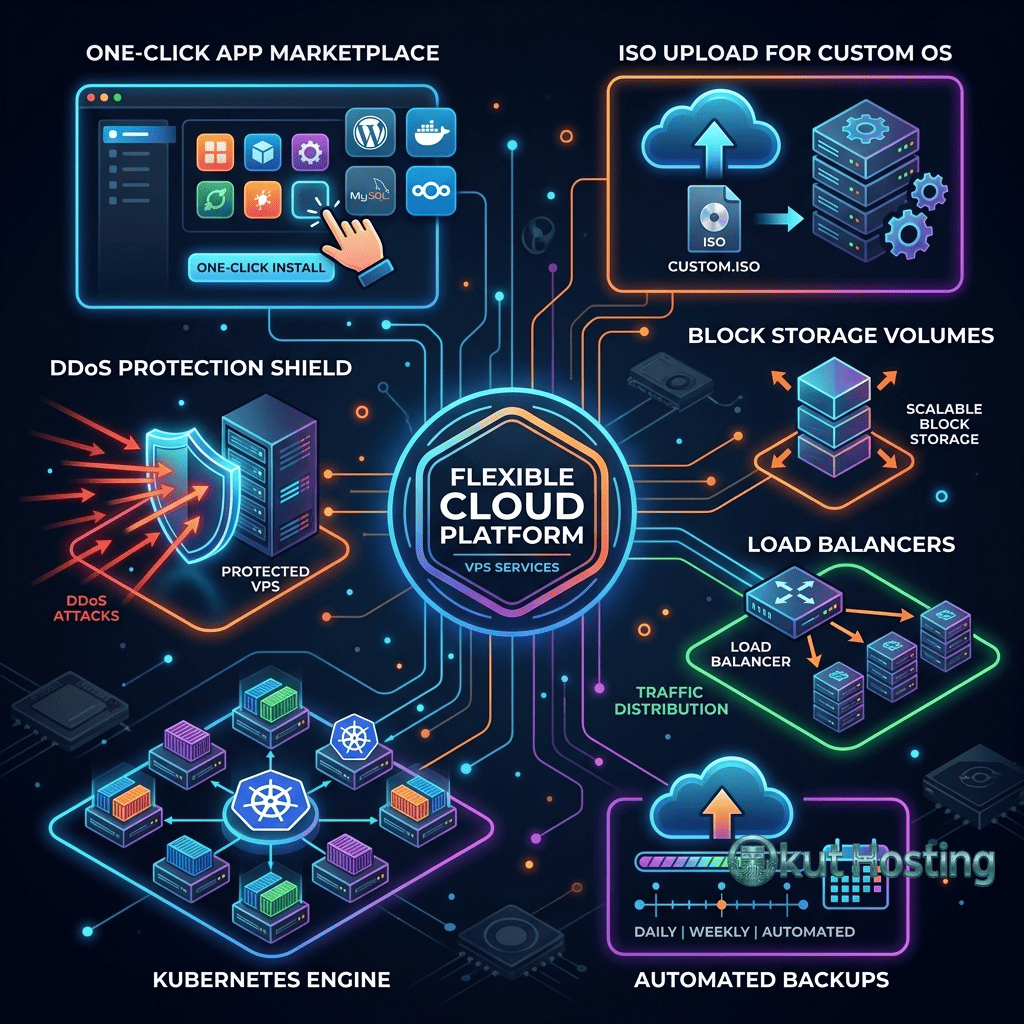
Vultr Kubernetes Engine (VKE) provides managed Kubernetes clusters for containerized workload orchestration. VKE handles the Kubernetes control plane management, enabling users to focus on deploying and managing containerized applications rather than managing the Kubernetes infrastructure itself. The managed Kubernetes service integrates with Vultr’s block storage and load balancer services for persistent storage and traffic distribution.
Networking and Load Balancing
Vultr provides comprehensive networking features including Virtual Private Cloud (VPC) for isolated private networking, floating IPs for high-availability configurations, and managed load balancers for distributing traffic across multiple instances. VPC networking enables secure communication between instances without traffic traversing the public internet.
BGP (Border Gateway Protocol) support is available for advanced networking configurations, enabling custom routing and IP address management. Reserved IP addresses provide static IP allocation for applications that require persistent IP addresses. IPv6 support is available on all instances, supporting modern networking requirements.
DNS Services
Vultr provides free DNS hosting with support for standard record types (A, AAAA, CNAME, MX, TXT, SRV, NS, CAA) and a globally distributed DNS infrastructure that provides fast resolution worldwide. The DNS service integrates with the Vultr API, enabling programmatic DNS management for automated deployments and dynamic DNS configurations. Free DNS hosting eliminates the need for separate DNS providers for basic domain management needs.
GPU Instances
Vultr offers GPU instances powered by NVIDIA GPUs for machine learning, deep learning, video processing, scientific computing, and GPU-accelerated application workloads. GPU instances provide direct access to GPU hardware through the NVIDIA CUDA toolkit and drivers, enabling high-performance parallel computing without the complexity of provisioning GPU resources on hyperscale cloud platforms. The availability of GPU instances on an independent cloud platform provides accessible GPU computing at competitive pricing for AI/ML researchers, data scientists, and developers working with GPU-accelerated applications.
Custom ISO and Operating Systems
Vultr’s custom ISO feature enables uploading and deploying any operating system ISO image on Vultr instances. This capability supports deploying specialized operating systems, custom Linux distributions, BSD variants, and other operating systems that are not available in the standard OS image library. Custom ISOs provide maximum flexibility for users with specific operating system requirements or custom deployment workflows. The standard OS library includes popular Linux distributions (Ubuntu, CentOS, Debian, Fedora, Arch Linux), Windows Server, and FreeBSD.
Storage Options
Block Storage provides persistent, attachable storage volumes that survive instance lifecycle events. Block storage is suitable for databases, application data, and any workload requiring persistent storage beyond the instance’s local SSD or NVMe storage. Volumes can be resized and moved between instances within the same data center region.
Object Storage provides S3-compatible storage for unstructured data including media files, backups, static website assets, and application data. The S3 API compatibility ensures that tools and applications designed for Amazon S3 work seamlessly with Vultr Object Storage. Object storage is available in select data center locations.
Developer Experience
Vultr provides a comprehensive developer experience through its web-based control panel, RESTful API, CLI tool (vultr-cli), and Terraform provider. The API enables full programmatic control over all Vultr resources, supporting automation, Infrastructure as Code workflows, and integration with CI/CD pipelines. The control panel provides an intuitive web interface for manual resource management.
Marketplace images provide one-click deployment of pre-configured application stacks including WordPress, Docker, GitLab, LAMP/LEMP stacks, popular monitoring tools, and development frameworks. Custom ISO uploads enable deploying any operating system that supports the hardware platform. Startup scripts enable automated post-deployment configuration. These tools collectively support both simple manual deployments and complex automated infrastructure management.
Security Features
Vultr implements infrastructure security through DDoS protection, firewalls, and data center physical security. Cloud Firewalls provide network-level access control for instances. Two-factor authentication secures account access. SSH key management enables secure server authentication. Snapshot and backup services provide data protection and recovery capabilities.
Compliance and Certifications
Vultr maintains SOC 2 Type II compliance certification, validating the security controls and operational procedures across the platform. Data center facilities maintain relevant physical security and environmental certifications. For organizations with compliance requirements, Vultr’s certifications and the extensive data center location options support geographic data residency requirements and regulatory compliance needs. The 30+ data center locations across multiple jurisdictions enable selecting hosting locations that satisfy specific data sovereignty requirements.
WordPress on Vultr
WordPress hosting on Vultr’s High Frequency Compute instances delivers excellent performance through high clock speed processors that optimize WordPress’s single-threaded PHP execution. A typical Vultr WordPress deployment uses a LEMP stack (Linux, Nginx, MySQL/MariaDB, PHP-FPM) with server-level caching through FastCGI cache or Redis object cache. This self-managed WordPress configuration provides superior performance compared to shared hosting at comparable or lower monthly cost, with full server control for custom optimization.
The marketplace provides one-click WordPress deployment that configures the LEMP stack, WordPress installation, and basic security hardening automatically. For users who prefer managed WordPress hosting without server administration, Vultr’s marketplace images provide a streamlined deployment experience. Advanced WordPress hosting configurations including multi-site deployments, staging environments, and high-availability setups are fully supported through manual server configuration.
Migration to Vultr
Migrating workloads to Vultr from other cloud providers or shared hosting is facilitated by standard Linux migration procedures, Vultr’s snapshot import capabilities, and compatibility with common migration tools. Server configurations can be replicated using Infrastructure as Code tools (Terraform, Ansible) that support Vultr’s API. Database migrations use standard MySQL/PostgreSQL dump and restore procedures. The hourly billing model enables testing workloads on Vultr before committing to full migration, reducing migration risk.
Cost Comparison Context
Vultr’s pricing competes directly with DigitalOcean and Linode at similar instance configurations, with specific price advantages varying by instance category and configuration. Compared to hyperscale providers (AWS, Google Cloud, Azure), Vultr typically provides significantly lower costs for comparable compute resources, particularly for predictable workloads that do not require the advanced managed services and enterprise features that hyperscale pricing subsidizes. For workloads that need straightforward cloud compute, storage, and networking without complex managed service ecosystems, Vultr’s transparent pricing delivers excellent value.
Vultr Cloud Inference
Vultr Cloud Inference provides serverless AI inference for deploying machine learning models as API endpoints. The inference platform supports popular ML frameworks and enables deploying trained models without managing the underlying GPU infrastructure. Cloud Inference makes AI capabilities accessible to developers and organizations that want to integrate machine learning into applications without the complexity of managing GPU instances for inference workloads. This service positions Vultr as a provider that supports the growing demand for accessible AI infrastructure.
Startup Scripts and Automation
Vultr’s startup script feature enables defining shell scripts that execute automatically when new instances are provisioned. Startup scripts automate post-deployment configuration including package installation, service configuration, application deployment, and security hardening. Combined with the API and Terraform provider, startup scripts enable fully automated infrastructure provisioning that requires zero manual intervention after the initial script development. This automation capability is essential for repeatable deployments, auto-scaling configurations, and disaster recovery procedures that need to provision new instances rapidly with consistent configurations.
API Ecosystem and Integration
Vultr’s RESTful API provides programmatic access to all platform services, enabling integration with custom applications, monitoring systems, CI/CD pipelines, and infrastructure management tools. The API supports OAuth authentication for secure programmatic access. Client libraries are available for popular programming languages including Python, Go, PHP, and JavaScript, reducing the development effort required for API integration. The comprehensive API enables building custom management dashboards, automated scaling systems, and infrastructure monitoring solutions that integrate deeply with the Vultr platform.
Customer Support
Vultr provides customer support through ticket-based email support. The support team handles platform-specific issues, billing inquiries, and infrastructure questions. Documentation provides comprehensive guides covering platform services, API usage, and common deployment scenarios. Community resources include forums and knowledge base articles.
Premium support plans are available for organizations requiring faster response times and dedicated support. The standard support response times are adequate for non-critical inquiries but may not meet the requirements of organizations with urgent infrastructure support needs.
Backup and Snapshots
Automated backups provide scheduled backup creation with configurable retention. On-demand snapshots enable creating point-in-time instance images for migration, scaling, and disaster recovery. Snapshots can be used to deploy new instances with identical configurations, enabling rapid horizontal scaling and environment replication.
Monitoring and Performance
Built-in monitoring provides CPU, memory, disk, and network metrics through the control panel. The monitoring interface displays real-time and historical performance data for capacity planning and troubleshooting. Integration with third-party monitoring services (Datadog, Prometheus, Grafana) provides comprehensive observability for complex infrastructure deployments.
Use Case Alignment
- WordPress and web hosting: High Frequency Compute instances provide the single-thread performance that WordPress and similar CMS platforms benefit from most.
- Development and testing: Low-cost shared CPU instances provide affordable compute for development environments and testing workloads.
- Global applications: The 30+ data center locations enable deploying close to any audience worldwide, reducing latency for globally distributed applications.
- Database hosting: Managed Databases and High Performance instances with NVMe storage deliver the I/O performance that database workloads require.
- Containerized workloads: Vultr Kubernetes Engine provides managed Kubernetes for container orchestration with integrated storage and networking.
Limitations
- Managed service breadth: Vultr’s managed service portfolio is less extensive than DigitalOcean’s, lacking equivalent PaaS and serverless offerings.
- Support limitations: Standard support is ticket-only without phone support; premium support requires additional cost.
- Community resources: Documentation and community tutorials are less extensive than DigitalOcean’s comprehensive tutorial library.
Summary
Vultr delivers cloud computing infrastructure that combines competitive pricing, extensive global data center coverage across 30+ locations on six continents, and a comprehensive product portfolio spanning shared and dedicated compute, high-frequency instances, bare metal servers, GPU instances, managed databases, and Kubernetes orchestration. The platform’s standout advantage is its unmatched global data center network — geographic coverage that exceeds any other independent cloud provider and approaches hyperscale provider reach at significantly lower complexity and cost.
For developers and organizations that need cloud infrastructure with truly global reach, transparent hourly pricing, and straightforward management, Vultr provides a compelling platform that balances performance, features, and value effectively. The platform is particularly well-suited for globally distributed applications, WordPress hosting on High Frequency instances, and workloads that benefit from data center location proximity to specific geographic audiences.
Features, pricing, and availability discussed in this review reflect information available at the time of writing. Please verify current details on the official Vultr website. Okut Hosting is an independent review platform with no affiliate relationships with any hosting company mentioned in this article.
For related reviews, see our DigitalOcean vs Linode comparison, our Linode vs Vultr comparison, and our guide to cloud server scaling.