Oracle Cloud Infrastructure (OCI) offers one of the most generous free tier programs in the cloud computing industry, providing always-free compute, storage, networking, and database resources that remain available indefinitely — not just for a trial period. While Oracle Cloud is often associated with enterprise database hosting and large-scale applications, the Always Free tier makes OCI’s infrastructure accessible to individual developers, students, small projects, and organizations evaluating Oracle’s cloud platform. The free tier program provides genuine production-capable resources that can host websites, applications, and databases at zero cost.
This review examines Oracle Cloud’s Free Tier in detail, covering the specific always-free resources, ARM-based compute instances, database services, networking capabilities, and the broader OCI platform that the free tier provides access to. The analysis evaluates the practical utility of the free tier for different use cases and the potential pathways from free to paid services.
Always-Free Compute Instances
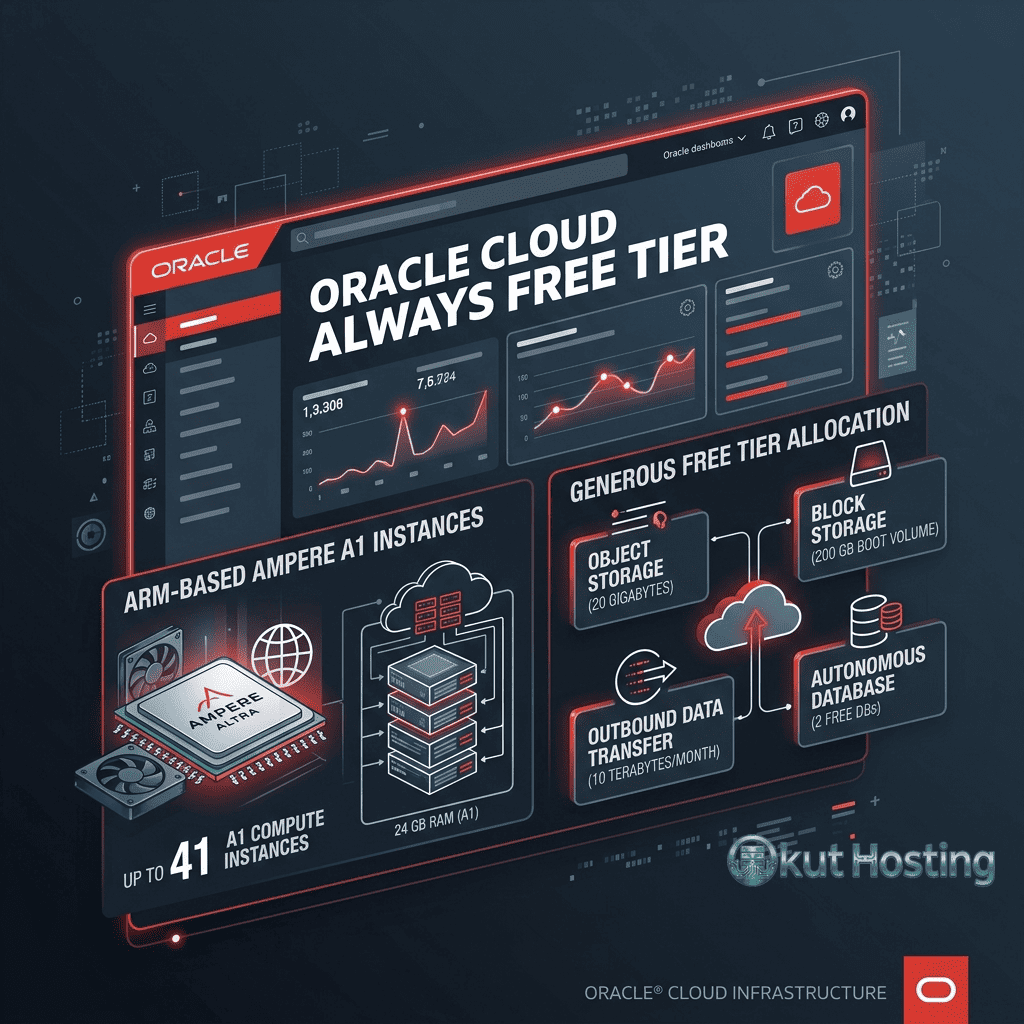
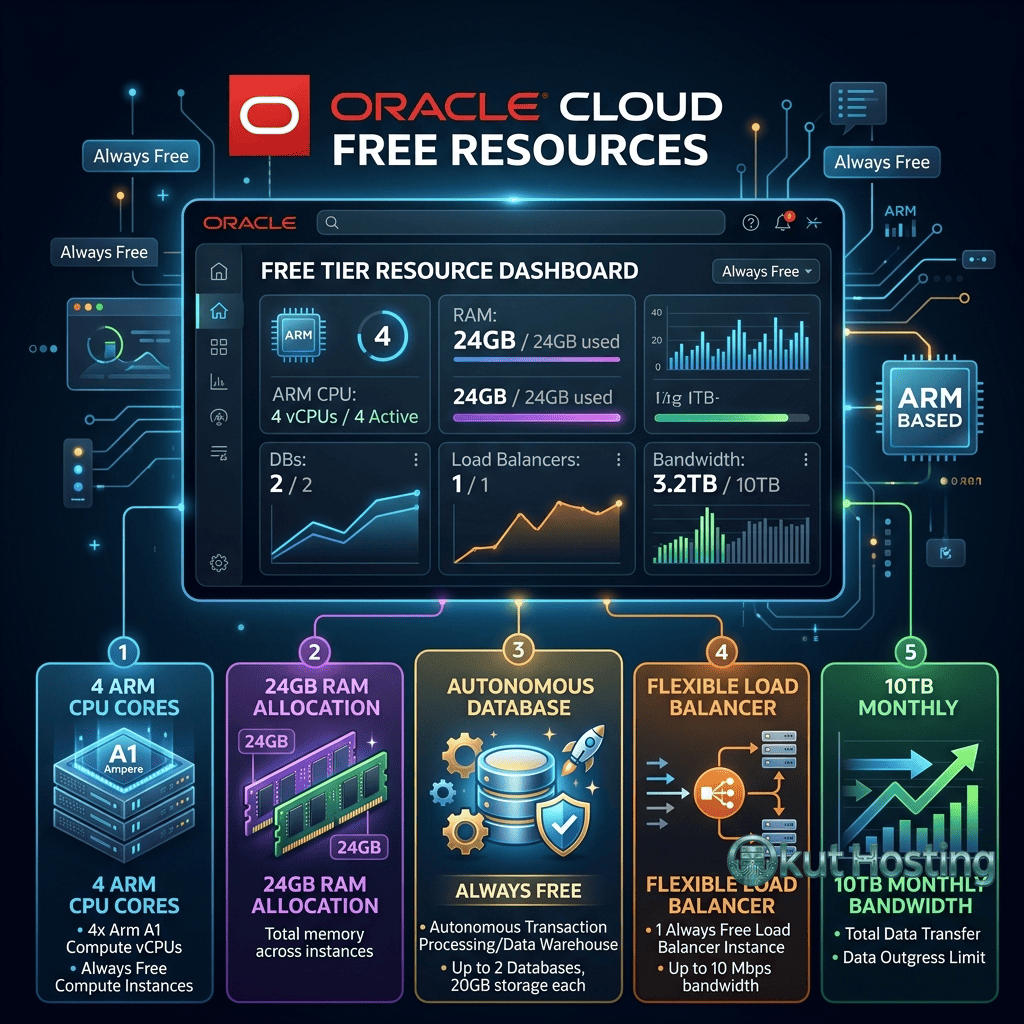
The OCI Always Free tier includes compute instances that remain free indefinitely. The most notable free compute resource is the ARM-based Ampere A1 allocation, which provides up to 4 OCPUs (Oracle Compute Processing Units) and 24 GB of memory — an exceptionally generous free allocation that exceeds the paid entry-level plans of most cloud providers. This ARM allocation can be used as a single large instance or divided across multiple smaller instances.
In addition to ARM instances, the free tier includes two AMD-based Micro instances with 1/8 OCPU and 1 GB memory each. While these AMD micro instances have very limited resources, they are sufficient for lightweight workloads like monitoring agents, small web services, and development utilities.
The ARM-based free instances deserve particular attention. With 4 OCPUs and 24 GB memory, the free ARM allocation provides resources comparable to mid-tier paid instances on competing platforms. This generous allocation enables hosting WordPress sites, small applications, development environments, and even moderate-production workloads at zero cost. The Ampere A1 ARM processors deliver competitive performance for web serving, database hosting, and application workloads that are compatible with the ARM architecture.
ARM Architecture Considerations
The ARM-based free instances require ARM-compatible software. Most Linux distributions (Ubuntu, Oracle Linux, CentOS) provide ARM builds that work seamlessly. Docker containers built for ARM architecture (or multi-architecture images) run natively. Popular web applications including WordPress, Node.js, Python/Django, and Go applications work on ARM without modification. However, some legacy software and applications compiled exclusively for x86 architecture may not be compatible.
For WordPress hosting, ARM instances provide excellent performance. The PHP runtime, MySQL/MariaDB database, and Nginx web server all have mature ARM support with optimized builds. WordPress performance benchmarks on Ampere A1 instances demonstrate competitive performance with x86 instances at equivalent resource specifications, validating ARM as a practical WordPress hosting platform.
Always-Free Storage
The free tier includes block volume storage (up to 200 GB total) and object storage (up to 20 GB). Block volumes provide persistent storage for compute instances, sufficient for operating system installations and application data. Object storage provides S3-compatible storage for backups, media files, and static assets. The storage allocations, while not unlimited, are adequate for many practical workloads including small websites, development projects, and personal applications.
Boot volumes for free-tier instances are included in the block volume allocation. Additional block volumes can be created and attached to instances within the free storage limit. The storage performance is adequate for most free-tier workloads, though performance-sensitive applications may benefit from paid storage tiers with higher IOPS guarantees.
Always-Free Database Services
Oracle Cloud’s free tier includes two Autonomous Database instances with 1 OCPU and 20 GB storage each. Autonomous Database is Oracle’s fully managed database service that automates provisioning, patching, tuning, backups, and scaling. The completely free Autonomous Database instances provide direct access to Oracle’s enterprise database technology — including both ATP (Autonomous Transaction Processing) for operational workloads and ADW (Autonomous Data Warehouse) for analytical workloads — at zero cost.
The inclusion of Autonomous Database in the free tier is a significant differentiator. No other major cloud provider includes fully managed enterprise database instances in their free tier programs at this level. For developers learning Oracle database technology, prototyping applications, or running small production workloads, the free Autonomous Database instances provide genuine value that is unique to Oracle Cloud.
Networking
The free tier includes Virtual Cloud Network (VCN) with subnets, security lists, route tables, and internet gateway — the complete networking infrastructure needed for production deployments. Load balancer service (1 flexible load balancer with 10 Mbps bandwidth) is included in the free tier, enabling traffic distribution across multiple free instances. The networking infrastructure supports complex, multi-tier application architectures within the free resource allocations.
Outbound data transfer of 10 TB per month is included in the free tier — significantly more generous than the bandwidth allowances included with paid plans at many competing providers. This generous bandwidth allocation enables hosting websites and applications with moderate traffic volumes without incurring bandwidth charges.
Monitoring and Observability
Free tier includes access to OCI Monitoring with up to 500 million monitoring data points ingestion per month, OCI Logging with 10 GB per month, and OCI Notifications for alert delivery. These observability services provide basic infrastructure monitoring, log management, and alerting capabilities at zero cost. The monitoring capabilities, while limited compared to paid tiers, are adequate for free-tier workloads.
Security Features
Free tier instances benefit from OCI’s enterprise security infrastructure including Virtual Cloud Network security lists and network security groups for traffic filtering, OCI Vault for secret management and key storage, and Web Application Firewall (WAF) basic protection. The security infrastructure available to free tier users is significantly more comprehensive than the security features typically available at free or entry-level tiers of competing cloud providers.
OCI’s security-first architecture provides defense-in-depth through network-level isolation (VCN with subnets and security lists), identity-based access control (OCI IAM with policies), and encryption at rest for block volumes and object storage. These security capabilities are essential for any production workload and are included at no additional cost for free tier users.
OCI Regions and Availability
Oracle Cloud operates data centers across multiple regions worldwide including North America, Europe, Asia-Pacific, Middle East, Africa, and South America. The geographic coverage provides deployment options for most global audiences. Free tier resources are available in all OCI regions, though specific resource availability may vary during high-demand periods. Users select their home region during account creation, which determines the primary location for free tier resources.
Container Services
The free tier includes Oracle Container Registry (OCIR) for storing Docker container images and Container Instances for running containers. Container Engine for Kubernetes (OKE) provides managed Kubernetes clusters where the control plane is free and users pay only for worker node compute. For free tier users, OKE worker nodes can use always-free compute instances, enabling hands-on managed Kubernetes experimentation and learning at zero cost. These container services enable learning and experimenting with containerized workloads on enterprise-grade infrastructure.
Infrastructure as Code
OCI supports Terraform for Infrastructure as Code management through the OCI Terraform provider. Terraform configurations enable defining and provisioning OCI resources programmatically, including free tier resources. Resource Manager provides OCI-native Terraform execution and state management. For users learning IaC practices, the free tier provides a cost-free environment for Terraform experimentation and skill development with real cloud infrastructure.
Cloud Shell provides a browser-based Linux terminal with pre-installed OCI CLI, Terraform, kubectl, and other development tools. Cloud Shell is available at no cost and provides immediate command-line access to OCI resources without local environment setup. This browser-based development environment reduces the barrier to managing OCI infrastructure, particularly for new users who may not have local development environments configured.
Additional Free Services
The always-free tier includes additional services beyond compute, storage, and databases: OCPU-based functions (Oracle Functions serverless compute), Email Delivery service, and OCI Vault for key management. These services extend the free tier beyond basic infrastructure into managed services that enable building complete applications at zero cost.
Account Setup and Verification
Oracle Cloud free tier accounts require credit card verification during registration but are not charged for always-free resource usage. The free tier remains available indefinitely as long as the account remains active. Oracle provides an additional $300 credit for 30 days on new accounts for evaluating paid services beyond the free tier. The credit card requirement serves as identity verification and prevents abuse of the free tier program.
The distinction between always-free and paid services is clearly indicated in the OCI console. Free tier users can optionally upgrade to a paid account to access additional services and resources while retaining access to always-free resources. The upgrade path enables seamless transition from free to paid as workload requirements grow beyond free tier allocations.
Free Tier DNS and Domain Management
OCI DNS provides domain name resolution services with support for public and private DNS zones. DNS management through the OCI console and API enables configuring A, AAAA, CNAME, MX, TXT, and other record types. The DNS service uses Oracle’s global anycast network for fast, reliable resolution. DNS hosting is available to free tier users, enabling complete domain management within the OCI platform without external DNS providers.
API Gateway
OCI API Gateway provides managed API endpoint creation, request routing, authentication, and rate limiting. The API Gateway service enables exposing backend services as managed APIs with security policies, CORS configuration, and request transformation. Free tier usage includes a limited number of API calls per month, enabling building and testing API-based architectures at zero cost.
Email Delivery Service
OCI Email Delivery provides managed email sending infrastructure for transactional and notification emails. The free tier includes a monthly email sending allocation sufficient for application notifications, user registration confirmations, password resets, and similar transactional email use cases. The email delivery service handles DKIM authentication, SPF configuration, and bounce handling, providing deliverability management that would otherwise require separate email service providers. For WordPress sites hosted on free tier instances, the email delivery service enables sending WordPress notification emails without third-party SMTP services.
Notifications and Events
OCI Notifications provides managed message delivery through email, SMS, Slack, PagerDuty, and webhook endpoints. OCI Events provides event-driven automation triggered by resource state changes within the OCI environment. Combined, these services enable building automated workflows that respond to infrastructure events — such as instance health changes, storage threshold alerts, and security events — with automated notifications and responses. The event-driven automation capabilities available to free tier users exceed what many cloud providers offer even on paid plans.
WordPress Hosting on Free Tier
Hosting WordPress on Oracle Cloud’s free ARM instances provides a genuinely compelling zero-cost hosting option. A typical free-tier WordPress deployment uses one ARM instance (2 OCPU, 12 GB memory — half the free allocation) running LEMP stack with WordPress, providing performance that exceeds many paid shared hosting plans. The generous memory allocation enables effective MySQL buffer pool sizing and PHP OPcache configuration that optimize WordPress performance.
Combined with the free load balancer and 10 TB monthly bandwidth, the free tier supports WordPress sites with meaningful traffic volumes without any hosting cost. For personal blogs, portfolio websites, small business marketing sites, development staging environments, and educational projects, Oracle Cloud’s free tier eliminates hosting costs entirely while providing cloud-level performance and control.
Limitations of Free Tier
- ARM architecture: Primary free compute is ARM-based, requiring ARM-compatible software and container images.
- Account deactivation risk: Inactive free accounts may be deactivated, requiring periodic usage to maintain resource availability.
- Support limitations: Free tier accounts receive basic support without premium support options.
- Geographic availability: Free tier resource availability may be limited in certain OCI regions during high-demand periods.
- Complexity: The OCI console and networking configuration are more complex than independent cloud providers, requiring more setup effort.
Comparison with Other Free Tiers
Oracle Cloud’s free tier is significantly more generous than the free tiers offered by AWS, Google Cloud, and Azure. AWS Free Tier provides a t2.micro instance (1 vCPU, 1 GB) for 12 months only. Google Cloud provides f1-micro instances with limited resources. Azure provides B1s instances for 12 months. None of these competitors provide always-free instances with the resource specifications that Oracle’s ARM allocation offers — 4 OCPUs and 24 GB memory indefinitely is entirely unmatched in the cloud hosting market today.
Best Practices for Free Tier Usage
To maximize the value of Oracle Cloud’s free tier, several best practices apply: use ARM instances for primary workloads since the ARM allocation provides significantly more resources than the AMD micro instances; implement automated monitoring to track resource usage and ensure the account remains active; configure automated backups within the free storage allocation; use the free load balancer for high-availability configurations; and leverage Autonomous Database for database workloads rather than self-managed database installations on compute instances.
For long-term free tier usage, maintaining account activity through regular console access or automated API calls prevents potential account deactivation due to inactivity. Documenting the infrastructure configuration through Terraform or manual documentation ensures that the environment can be rebuilt if account recovery is needed.
Community and Learning Resources
Oracle Cloud’s community includes comprehensive documentation, Oracle Cloud tutorials, hands-on labs, and certification programs. The Oracle Cloud Infrastructure Foundations certification provides structured learning for cloud infrastructure concepts. Community forums and Oracle’s developer advocacy programs provide support and knowledge sharing for OCI users including free tier participants. The extensive learning resources and hands-on labs are particularly valuable for students and aspiring professionals building cloud computing skills on production-grade infrastructure at zero cost.
Broader OCI Platform
Beyond the free tier, Oracle Cloud Infrastructure provides enterprise-grade cloud services including Compute Engine (x86 and ARM instances), Block Volume, Object Storage, Container Engine for Kubernetes (OKE), Autonomous Database, Exadata Cloud Service, and Data Integration services. The broader and more comprehensive platform targets enterprise workloads with Oracle’s database and middleware technology integration providing unique value for Oracle technology environments.
Summary
Oracle Cloud Infrastructure’s Always Free tier provides the most generous free cloud computing resources available, headlined by ARM-based Ampere A1 instances with up to 4 OCPUs and 24 GB memory available indefinitely. Combined with free Autonomous Database instances, block storage, object storage, load balancing, and generous bandwidth, the free tier enables hosting production-capable applications at genuinely zero cost. For WordPress hosting, development environments, learning cloud computing, and small production workloads, Oracle Cloud’s free tier provides exceptional value that no competing cloud provider matches.
The primary trade-offs — ARM architecture requirements, OCI console complexity, and potential account inactivity deactivation — are manageable for technically capable users who want to leverage free cloud resources. The free tier serves both as a compelling hosting option for cost-conscious users and as an effective onboarding path into Oracle Cloud’s broader enterprise platform.
Features, pricing, and availability discussed in this review reflect information available at the time of writing. Please verify current details on the official Oracle Cloud website. Okut Hosting is an independent review platform with no affiliate relationships with any hosting company mentioned in this article.
For related reviews, see our AWS Lightsail review, our Google Cloud Compute review, and our guide to cloud server scaling.