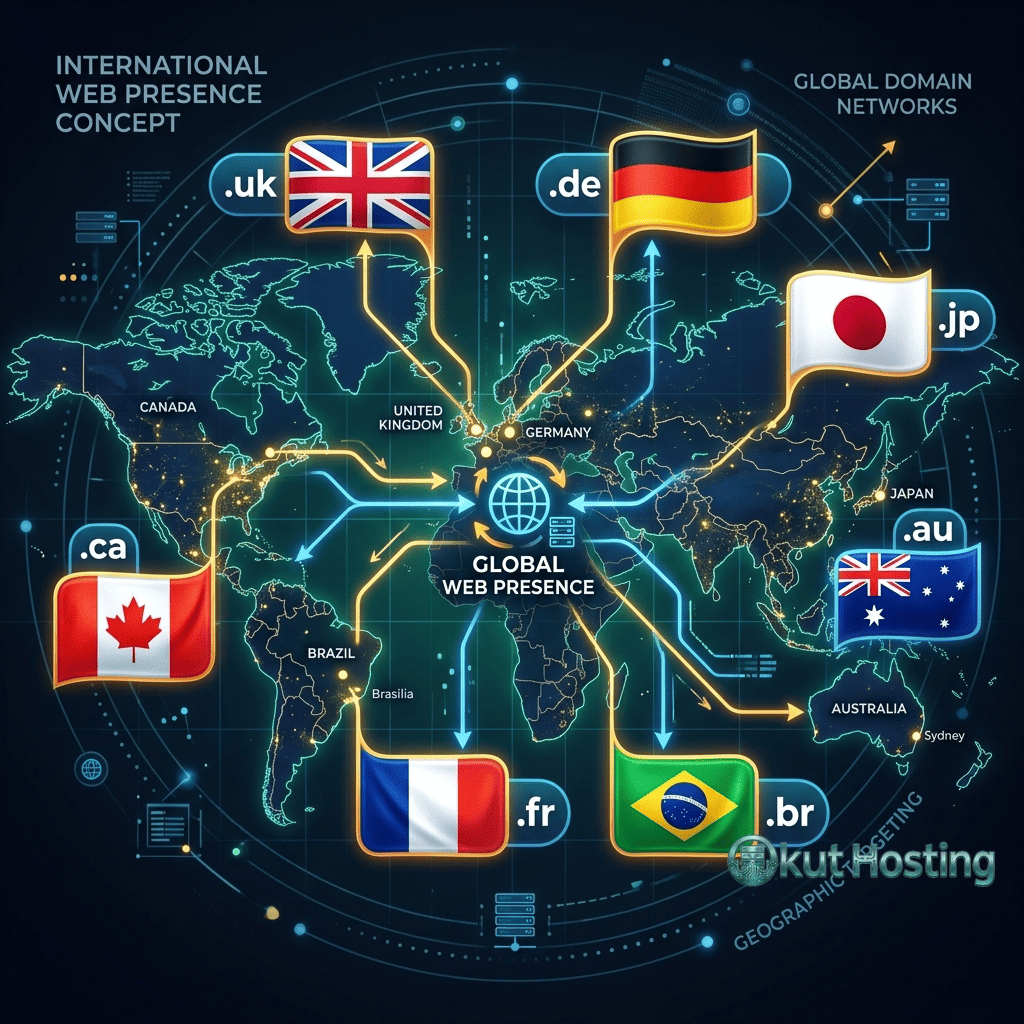
Country-code top-level domains (ccTLDs) are two-letter domain extensions assigned to specific countries and territories based on ISO 3166-1 alpha-2 country codes. Examples include .us (United States), .uk (United Kingdom), .de (Germany), .fr (France), .ca (Canada), .au (Australia), .jp (Japan), and .br (Brazil). ccTLDs serve as established geographic identifiers in the domain name system, signaling national association and enabling businesses, organizations, and individuals to establish domain presence with explicit geographic context.
This comprehensive guide examines country-code domain selection thoroughly, covering geographic targeting advantages, SEO implications, registration requirements and restrictions, popular ccTLDs for both geographic and creative uses, pricing considerations, and decision frameworks for choosing between ccTLDs and generic TLDs. The analysis provides neutral and practical guidance for domain buyers evaluating country-code extensions for their websites and online services.
Geographic Targeting with ccTLDs
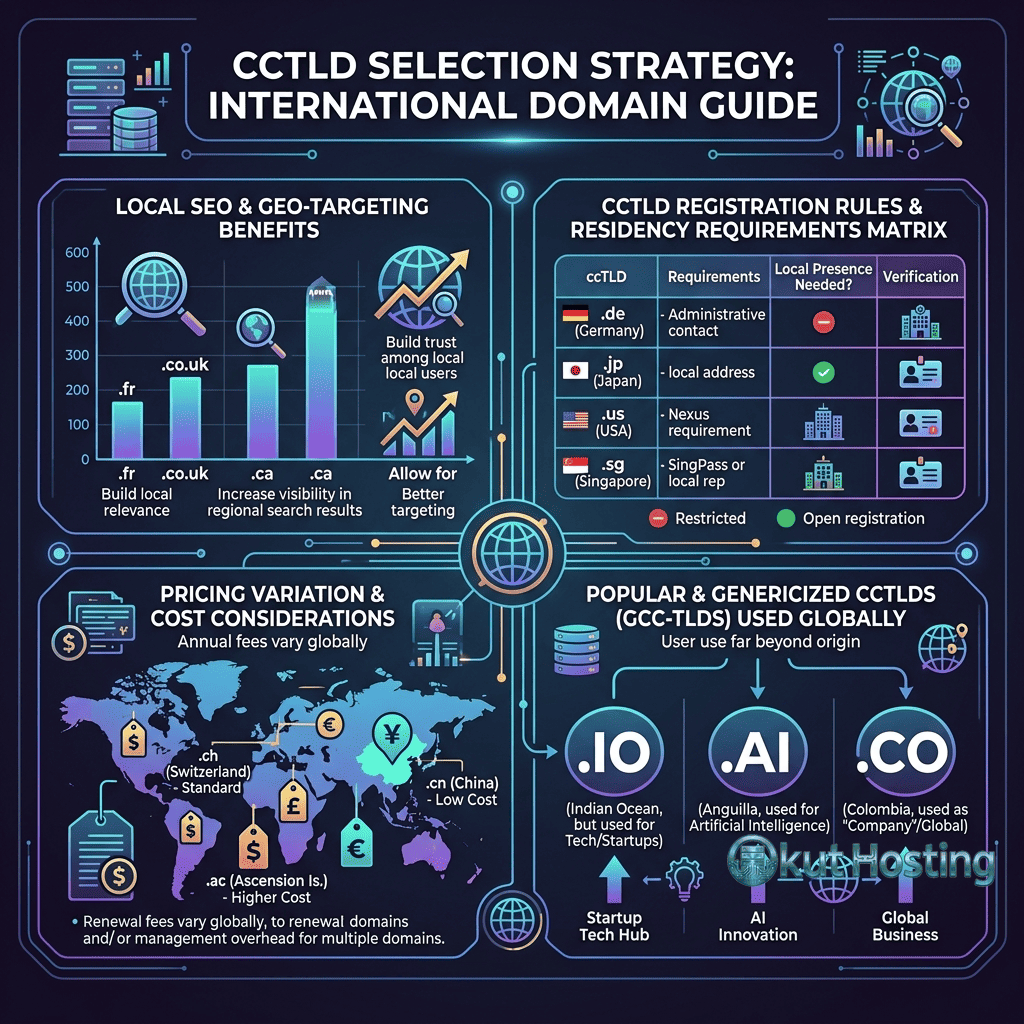
Country-code domains provide immediate geographic context that communicates national focus to both users and search engines. A business operating on a .de domain immediately and clearly signals German market focus, while a .co.uk domain clearly communicates UK presence. This geographic signaling meaningfully influences user trust and search engine behavior in the target country. Users in a specific country often prefer and trust websites using their national ccTLD, viewing them as more locally relevant, accountable, and legitimate than generic .com alternatives.
For businesses that operate exclusively or primarily within a single country, a ccTLD reinforces local market positioning and establishes geographic credibility with the target audience. National ccTLDs are particularly effective for: local service businesses serving geographic markets; e-commerce sites targeting specific national markets; news and media organizations with national focus; government and institutional websites; and businesses required by regulation to demonstrate national presence.
SEO Impact of ccTLDs
Search engines use ccTLDs as a geographic signal when determining the relevance of websites for country-specific search queries. A .de domain receives a ranking advantage for search queries from German users compared to a generic .com domain (assuming equivalent content quality and relevance). This geo-targeting signal is one of the strongest geographic indicators that search engines consider, alongside server location, content language, and Google Search Console geographic targeting settings.
However, the SEO advantage of ccTLDs is specifically geographic — a ccTLD improves relevance for the target country but may reduce visibility in other countries. A .de domain may rank lower in French search results compared to a .com domain targeting France. For businesses targeting multiple countries, separate ccTLD domains for each market (with localized content) or a single generic TLD with international SEO configuration provides broader geographic reach than a single ccTLD.
Popular ccTLDs by Region
Europe
.uk / .co.uk (United Kingdom): One of the most widely used ccTLDs globally, .uk and the traditional .co.uk provide strong geographic targeting for the UK market. .uk is the newer, shorter format while .co.uk remains widely used and recognized. .de (Germany): Germany’s ccTLD is the most registered ccTLD in Europe, reflecting the country’s large and established online economy. .fr (France): Used extensively by French businesses and organizations. .nl (Netherlands): Popular among Dutch businesses and tech companies. .it (Italy), .es (Spain), .pl (Poland): Active ccTLDs in their respective markets.
Asia-Pacific
.jp (Japan): Japan’s ccTLD with strict registration requirements typically limiting registration to Japanese entities. .cn (China): China’s ccTLD with the largest registration base in Asia. .au (Australia): Australia’s ccTLD with eligibility requirements for Australian entities. .in (India): India’s ccTLD with growing registration volumes reflecting India’s expanding internet economy. .kr (South Korea): Used by Korean businesses and organizations.
Americas
.ca (Canada): Canada’s ccTLD with Canadian Presence Requirements (CPR) limiting registration to Canadian individuals and entities. .br (Brazil): Latin America’s largest ccTLD market with significant registration volumes. .mx (Mexico): Mexico’s ccTLD serving the growing Mexican digital market. .us (United States): Though less commonly used than .com for US businesses, .us provides explicit American geographic targeting. .ar (Argentina): Argentina’s ccTLD for the Argentine market. .cl (Chile): Chile’s ccTLD with growing adoption among Chilean businesses and organizations.
Middle East and Africa
.ae (United Arab Emirates): The UAE’s ccTLD used by businesses and organizations in Dubai, Abu Dhabi, and across the Emirates. .sa (Saudi Arabia): Saudi Arabia’s ccTLD with registration requirements for Saudi entities. .za (South Africa): South Africa’s ccTLD with second-level categorization (.co.za for commercial). .ng (Nigeria): Nigeria’s ccTLD serving Africa’s largest internet market. .eg (Egypt): Egypt’s ccTLD for the Egyptian digital market. .ke (Kenya): Kenya’s ccTLD reflecting East Africa’s growing tech ecosystem. These important Middle Eastern and African ccTLDs represent rapidly growing and dynamic markets with increasing domain registration activity as internet adoption expands across these regions.
Repurposed ccTLDs
Several ccTLDs have been commercially repurposed for non-geographic uses based on their letter combinations, creating new semantic meanings unrelated to their original country designation. Notable examples include:
.io (British Indian Ocean Territory) — widely adopted by technology companies for its association with input/output computing concepts. .ai (Anguilla) — adopted by artificial intelligence companies and services. .tv (Tuvalu) — used by television, streaming, and video content creators. .fm (Federated States of Micronesia) — used by radio stations, podcasts, and audio platforms. .me (Montenegro) — used for personal branding and portfolio websites. .co (Colombia) — marketed as a commercial alternative to .com. .ly (Libya) — used for URL shorteners and analytics services (bit.ly).
These repurposed ccTLDs generate significant revenue for the small nations that administer them, with .tv revenue reportedly representing a meaningful portion of Tuvalu’s national income. However, using repurposed ccTLDs carries the risk of dependency on the administering country’s political stability and domain administration policies.
Registration Requirements and Restrictions
ccTLD registration requirements vary significantly between countries. Some ccTLDs are open for global registration without restrictions (including .co, .me, .io, .tv), while others have specific eligibility requirements. Common restrictions include: residency requirements (registrants must be residents or citizens of the country); local presence requirements (registrants must have a registered business or legal entity in the country); identity verification (registrants must provide government-issued identification); and use restrictions (domains must be used for purposes aligned with the country’s policies).
Examples of restricted ccTLDs: .ca requires Canadian Presence Requirements; .au requires Australian entity registration; .jp typically requires Japanese entity or local representation; .eu requires EU/EEA residency or establishment. Fully open ccTLDs like .co, .me, and .io allow registration by anyone regardless of geographic location, which has facilitated their adoption for non-geographic purposes.
Second-Level Domains
Many countries organize their ccTLD namespace with second-level categories that indicate the type of registrant. Common examples include: .co.uk (commercial UK), .org.uk (organizational UK), .ac.uk (academic UK); .com.au (commercial Australia), .edu.au (educational Australia); .co.jp (commercial Japan), .ac.jp (academic Japan). These carefully categorized second-level domains provide additional organizational context and classification within the country’s domain namespace. Some countries allow both direct registrations (example.de) and categorized registrations (example.co.uk), while others use one structure exclusively.
ccTLD Pricing
ccTLD pricing varies widely between countries and registrars. Common ccTLDs like .uk, .de, and .co are priced competitively with generic TLDs at approximately $8-15 per year. Repurposed ccTLDs like .io, .ai, and .tv command premium pricing ($25-80+ per year) due to their commercial popularity and registrant demand. Some country-specific ccTLDs have higher administrative costs reflecting local registry fees and compliance requirements. the total annual cost of ccTLD ownership should include both registration/renewal pricing and any additional compliance costs (local representation, identity verification, etc.).
Multi-Country Domain Strategy
Businesses operating in multiple countries face strategic decisions about domain architecture. common strategic approaches include: separate ccTLD domains for each market (example.de, example.fr, example.co.uk) with localized content; a single generic TLD (example.com) with country-specific subdirectories (/de/, /fr/, /uk/); a single generic TLD with country-specific subdomains (de.example.com, fr.example.com); or a combination approach using the primary ccTLD for the home market and a generic TLD for international presence.
Each approach has significant trade-offs: separate ccTLDs provide strongest geographic signals but require managing multiple domains; subdirectories consolidate domain authority but provide weaker geographic signals; and subdomains provide organizational clarity but may dilute domain authority across multiple subdomains. the optimal strategy ultimately depends on the business’s international scope, resource capacity for managing multiple domains, and SEO prioritization across target markets.
ccTLD vs Generic TLD Decision Framework
Choose a ccTLD when: the business serves primarily one national market; local user trust and geographic credibility are important; local search engine visibility is prioritized; and the target market has strong ccTLD adoption and recognition. Choose a generic TLD when: the business serves international audiences; content is not country-specific; maximum global reach is desired; and the business may expand to new markets in the future. Consider both (ccTLD + generic) when: brand protection across markets is important; the business has resources to manage multiple domains; and both local and international visibility are strategic priorities.
ccTLD Transfer and Migration
Transferring ccTLD domains between registrars may follow different procedures than generic TLD transfers. Each ccTLD registry has its own transfer policies, which may include different authorization mechanisms, lock periods, and eligibility verification. Before transferring a ccTLD, domain owners should verify the specific transfer procedures for their extension with both the current and gaining registrars.
DNSSEC and ccTLD Support
DNSSEC support varies by ccTLD registry. Major ccTLDs including .uk, .de, .fr, and .nl support DNSSEC for domain authentication. Some smaller ccTLDs may not yet support DNSSEC. For domains requiring DNS authentication, verifying DNSSEC support with the specific ccTLD registry is important when selecting a country-code extension.
WHOIS Privacy for ccTLDs
WHOIS privacy availability varies significantly across ccTLDs. Some country-code registries allow standard WHOIS privacy services (proxy registration), while others require accurate public registration data. For example, .us domains require accurate registrant information without privacy proxy services under the Nexus Policy. .ca domains allow limited privacy through CIRA’s WHOIS privacy service. .uk domains have their own privacy provisions through the Nominet registry. Domain buyers should carefully verify WHOIS privacy availability for their chosen ccTLD before registration if privacy protection is a priority.
Internationalized Domain Names (IDNs)
Many ccTLD registries support Internationalized Domain Names that use non-Latin characters, enabling domain registration in the local language script. Arabic-script domains (.مصر for Egypt), Chinese character domains (.中国 for China), and Cyrillic-script domains (.рф for Russia) provide domain names in native scripts rather than Latin transliterations. IDN support enables culturally appropriate and authentic domain names for audiences that primarily use non-Latin scripts, though adoption has been limited compared to standard Latin-character domains due to technical compatibility considerations and user familiarity.
WordPress and ccTLD Compatibility
Country-code domains are fully compatible with WordPress and all hosting platforms through standard DNS configuration. The ccTLD choice does not affect WordPress functionality, theme compatibility, plugin operation, or hosting provider options. For WordPress sites targeting specific national markets, a ccTLD provides geographic SEO signals that complement WordPress’s SEO plugins and content optimization capabilities. WordPress multisite installations can use ccTLD domains for different country versions of a website, managing multiple national sites from a single WordPress installation.
Email Configuration with ccTLDs
Email services work identically with ccTLD domains as with generic TLD domains. MX records for Google Workspace, Microsoft 365, or any email hosting provider are configured the same way regardless of the domain extension. Professional email addresses using ccTLD domains (contact@company.co.uk) provide geographic credibility in business communications. Email authentication records (SPF, DKIM, DMARC) are configured identically for ccTLDs and generic TLDs.
Brand Protection with ccTLDs
International brands often register their brand name across multiple ccTLDs as a defensive strategy to prevent cybersquatting, brand impersonation, and competitor domain registration. Major corporations typically maintain registrations across dozens of ccTLDs for their primary brand names. For smaller businesses, prioritizing ccTLD registrations in countries where the business operates or plans to expand provides targeted brand protection without the cost of comprehensive global coverage.
ccTLD Renewal and Expiration
ccTLD renewal policies, grace periods, and redemption periods vary by registry. Some ccTLD registries have shorter grace periods than generic TLD registries, meaning expired ccTLD domains may become available for new registration more quickly. Domain owners managing ccTLD portfolios should understand the specific renewal timelines and expiration policies for each ccTLD to prevent accidental domain loss due to registry-specific policy differences.
Legal Jurisdiction Considerations
using a ccTLD may subject the domain and its operator to the legal jurisdiction of the corresponding country. Disputes involving .de domains may be adjudicated under German law, .uk domain disputes may fall under UK jurisdiction, and .cn domains are subject to Chinese regulations. For businesses operating internationally, the important legal implications of ccTLD selection should be considered alongside geographic targeting benefits. the specific ccTLD registry’s dispute resolution policies and the country’s domain-related legal framework directly influence how domain ownership disputes and conflicts are resolved.
Future of ccTLDs
Country-code domains continue evolving rapidly as internet adoption grows globally and new markets emerge. The increasing digital economy in Africa, the Middle East, and Southeast Asia is driving ccTLD adoption in previously underserved regions. The creative commercial repurposing of ccTLDs for non-geographic uses continues with extensions like .ai experiencing explosive growth driven by the artificial intelligence industry. Regulatory developments including GDPR and country-specific internet regulations continue shaping ccTLD policies and privacy protections.
SSL Certificates and ccTLDs
SSL certificates work identically with ccTLD domains as with generic TLDs. Domain Validation (DV), Organization Validation (OV), and Extended Validation (EV) certificates from major Certificate Authorities are available for all ccTLDs. Let’s Encrypt provides free DV certificates for ccTLD domains through the same automated process used for generic TLDs. The domain extension does not affect SSL certificate pricing, availability, or functionality. For e-commerce sites using ccTLDs, SSL implementation follows the same procedures and provides the same encryption protection as sites using .com or other generic extensions.
E-Commerce Considerations
For e-commerce businesses, ccTLD selection affects customer trust, payment gateway compatibility, and local market perception. Customers in many countries prefer purchasing from websites using their national ccTLD, perceiving them as more trustworthy and locally accountable. Payment gateways and local payment methods may display differently or have different integration requirements based on the domain’s geographic signal. Local tax compliance, consumer protection regulations, and shipping logistics may also be influenced by the geographic association of the ccTLD. E-commerce businesses targeting specific national markets should consider ccTLD adoption as part of their comprehensive local market strategy.
Summary
Country-code domains provide geographic targeting, local trust, and search engine geo-signals that strengthen online presence in specific national markets. the diverse ccTLD landscape includes both traditional geographic uses and creative commercial repurposing of extensions like .io, .ai, and .tv. Selecting the most appropriate ccTLD requires carefully evaluating registration requirements, pricing, geographic targeting goals, and long-term domain strategy. For businesses with clear and focused national market focus, ccTLDs provide meaningful and demonstrable advantages; for businesses targeting global audiences, generic TLDs typically provide much broader reach with fewer geographic constraints.
Information discussed in this guide reflects general ccTLD practices and policies. Registration requirements, pricing, and policies vary by country and change over time. Okut Hosting is an independent review platform with no affiliate relationships with any company mentioned in this article.
For related guides, see our domain name extensions guide, our DNS management basics, and our GoDaddy vs Namecheap comparison.