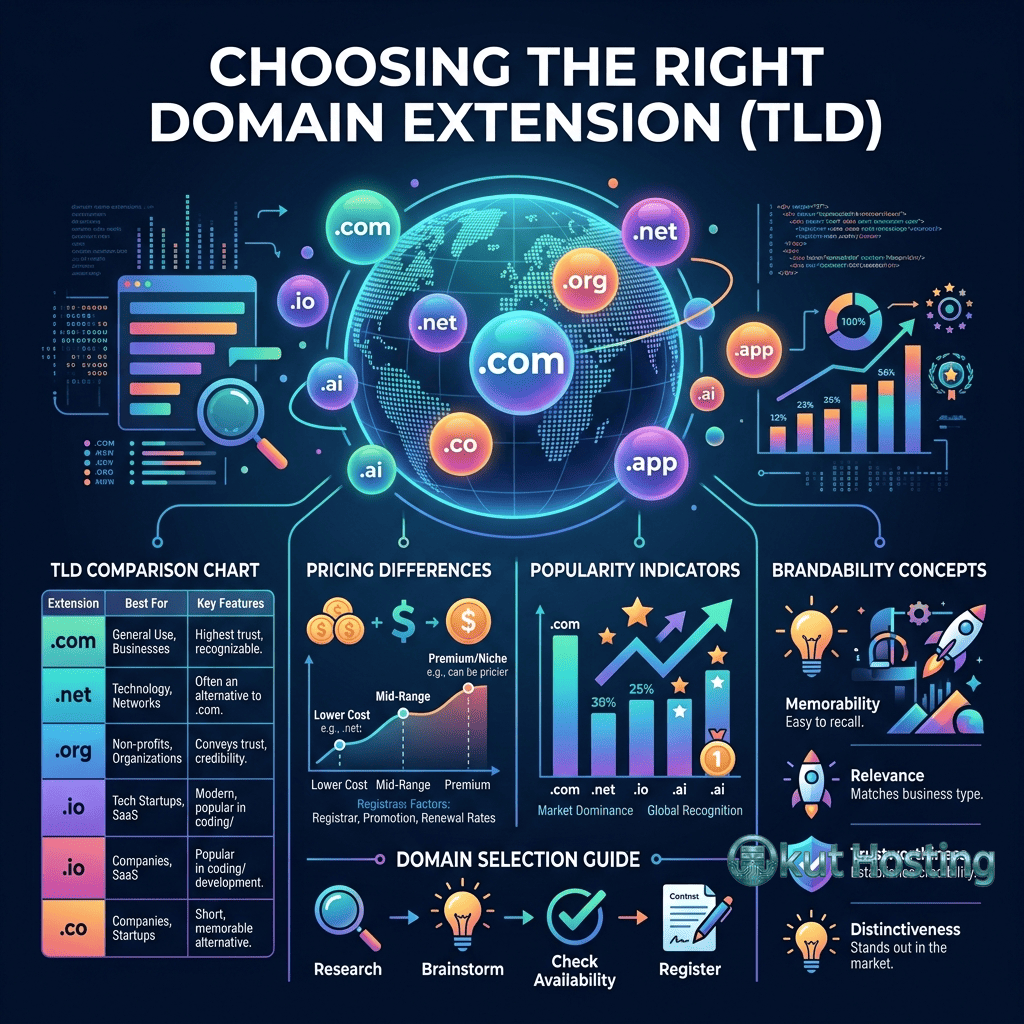
Domain name extensions — technically called top-level domains (TLDs) — are the suffixes that follow the dot in a domain name (.com, .io, .net, .org, .dev). The choice of domain extension influences brand perception, user trust, memorability, search engine behavior, pricing, and availability of desired domain names. With over 1,500 distinct TLD options now available compared to the handful of original extensions, selecting the most appropriate TLD requires understanding the technical, branding, and practical implications of each option.
This guide examines the most popular domain extensions, analyzes the factors that influence TLD selection, addresses common questions about SEO impact and user trust, and provides a decision framework for choosing the most appropriate extension for different website purposes. The analysis maintains full technical accuracy and practical relevance for domain buyers making extension decisions.
.com — The Universal Standard
.com (commercial) remains the most widely recognized and commonly used TLD globally. Registered through Verisign, .com domains account for approximately 160 million registrations — more than any other single TLD. The extension’s universal recognition means that most internet users assume websites use .com by default, and many people will type .com automatically when attempting to visit a website from memory.
The universal recognition of .com provides several practical advantages: higher inherent user trust compared to less familiar extensions; better memorability since users expect .com endings; significantly lower risk of type-in traffic loss to the .com version of the same domain name; and broader international recognition across all markets and languages. The primary practical disadvantage is availability — with 160+ million registered .com domains, finding short, descriptive, brandable, or keyword-rich .com domains is increasingly difficult and expensive.
.com pricing is standardized across registrars at approximately $8-15 per year for registration and renewal, with premium .com domains (short, keyword-rich, or brandable names) commanding significantly higher prices on the secondary market.
.net — The Network Alternative
.net (network) is the second most recognized generic TLD, originally intended for network infrastructure organizations but now used broadly for any purpose. With approximately 13 million registrations, .net provides a familiar, established alternative when the desired .com domain is unavailable. Many highly successful businesses and websites operate on .net domains without any negative brand perception.
.net domains are typically priced similarly to .com at most registrars. The extension carries strong recognition and established trust, though slightly lower than .com in general consumer perception surveys. For technology companies, networking services, and internet infrastructure businesses, .net carries natural semantic relevance that reinforces the brand positioning.
.org — The Organization Extension
.org (organization) was originally designated for non-profit organizations, though it is now open for registration by any entity. The extension maintains a strong association with non-profit, educational, open-source, and community-focused organizations. Major organizations including Wikipedia (.org), Mozilla (.org), and the Internet Engineering Task Force (.org) reinforce this association.
For non-profit organizations, advocacy groups, open-source community projects, and community initiatives, .org provides appropriate branding that communicates organizational mission. For commercial businesses, .org may create misleading impressions about the organization’s nature and is generally not recommended. .org pricing is similar to .com and .net at most registrars.
.io — The Tech Industry Favorite
.io is technically the country-code TLD for the British Indian Ocean Territory but has been widely adopted by technology companies, startups, and developer-focused services. The extension’s widespread popularity in the tech industry stems from its natural association with input/output (I/O) in computing, its short and memorable format, and the availability of desirable domain names that are unavailable in .com.
Major technology companies and services using .io include GitHub Pages, Figma, Replit, and numerous developer tools and APIs. The extension signals technology orientation and modern positioning, making it particularly effective for SaaS products, developer tools, API services, and technology startups. However, .io pricing is typically $30-60 per year — significantly more expensive than .com — which is an important consideration for budget-conscious domain buyers.
A practical consideration for .io domains is the uncertain long-term status of the British Indian Ocean Territory as a political entity, which could theoretically affect the TLD’s future administration. While immediate disruption is unlikely, this geopolitical uncertainty distinguishes .io from generic TLDs that are not tied to specific territories.
.dev — Google’s Developer Extension
.dev is a relatively new TLD operated by Google Registry, specifically designed for developers and development-related content. A distinctive feature of .dev is that it requires HTTPS — all .dev domains are pre-loaded in the HSTS (HTTP Strict Transport Security) list, meaning browsers will only connect to .dev domains over encrypted connections. This built-in security requirement makes .dev a technically appropriate choice for developer portfolios, documentation, and development projects.
.dev domains are typically priced at $12-20 per year, making them more affordable than .io while maintaining strong developer community recognition. The HTTPS requirement eliminates the possibility of accidentally serving content over unencrypted HTTP connections.
.app — Mobile and Application Extension
.app is another Google Registry TLD designed for applications and app-related content. Like .dev, .app requires HTTPS through HSTS preloading. The extension is particularly appropriate for mobile applications, web applications, and software products. .app provides clear semantic relevance for application-focused domains and benefits from Google Registry’s stable administration.
.co — The Startup Alternative
.co is the country-code TLD for Colombia but has been actively marketed as a global alternative to .com, particularly for startups and new businesses. The extension’s similarity to .com provides some recognition benefit, though it also creates risk of type-in traffic loss to the .com version. Major companies including Twitter (t.co for URL shortening) and Google (.co domains for some services) have used .co domains, lending credibility to the extension.
.info — The Information Extension
.info was introduced as a TLD for informational websites and remains available for general registration. The extension is appropriate for information-focused websites, knowledge bases, and resource directories. .info pricing is typically among the lowest for established TLDs, making it a budget-friendly option. However, .info has experienced higher rates of spam domain registration compared to .com and .net, which has impacted its perceived trustworthiness among some internet users. For legitimate information websites with quality content, .info remains a functional and affordable extension choice.
.biz — The Business Extension
.biz was introduced as a business-focused alternative to .com. Despite its commercial intent, .biz has not achieved the mainstream adoption or recognition of .com, .net, or .org. The extension is available at low prices and provides an alternative when .com versions are unavailable. However, .biz carries lower perceived trust than more established extensions and is generally recommended only when more recognized alternatives are not available for the desired domain name.
.xyz — The Affordable Universal Extension
.xyz is a generic TLD that launched in 2014 and quickly became popular due to very low pricing (often under $2 for first-year registration). Google’s parent company Alphabet uses abc.xyz as its corporate website, providing significant credibility for the extension. .xyz is appropriate for creative projects, experimental sites, personal portfolios, and budget-conscious domain buyers. However, the very low pricing has also attracted spam and low-quality registrations, which may unfortunately impact the extension’s perceived trustworthiness among some users.
Country-Code TLDs
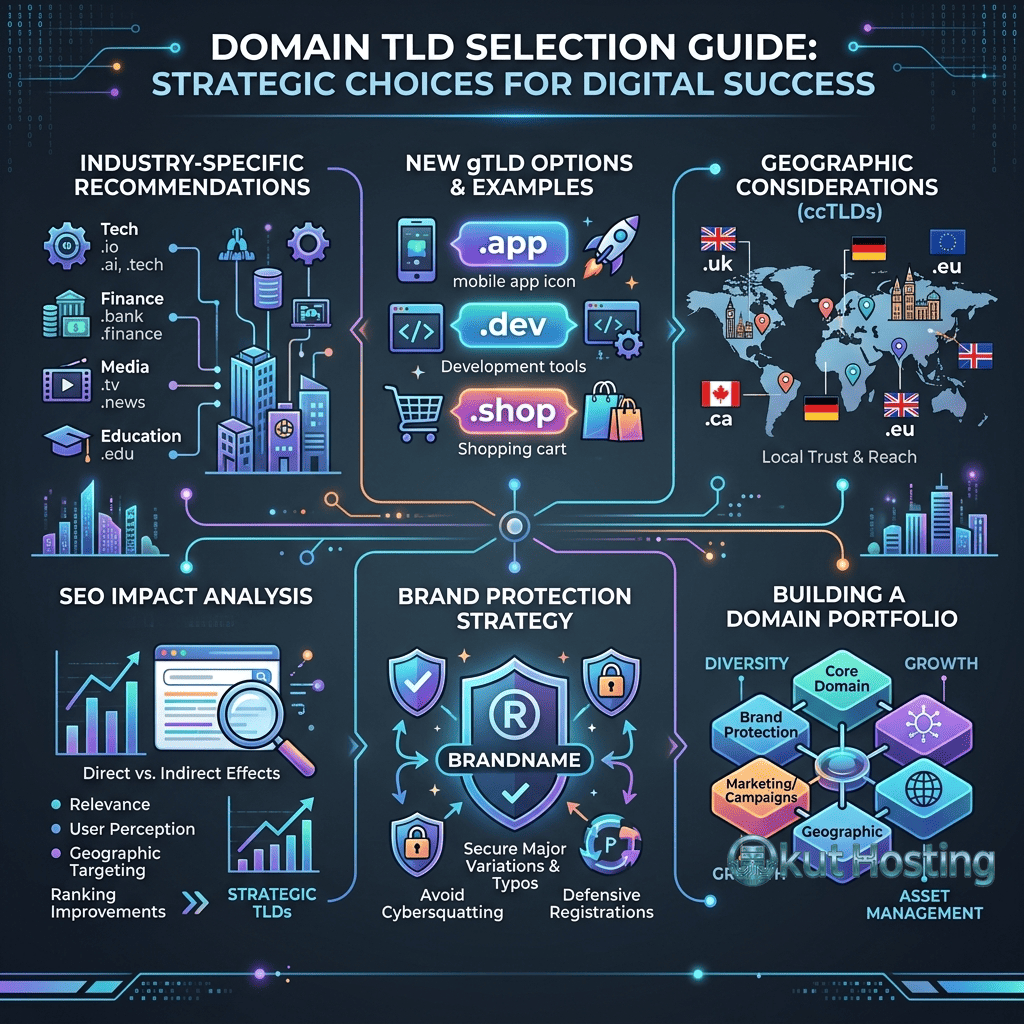
Country-code TLDs (.us, .uk, .de, .fr, .ca, .au) are designated for specific countries and provide geographic targeting for businesses serving specific national markets. Using a country-code TLD signals local presence and can improve search engine visibility for local search queries. For businesses operating primarily in a single country, the country-code TLD can strengthen local brand identity.
Some country-code TLDs have been repurposed for non-geographic uses: .tv (Tuvalu) for video and streaming content; .me (Montenegro) for personal branding; .ai (Anguilla) for artificial intelligence companies; .fm (Federated States of Micronesia) for audio and podcast content. These creative and popular TLD uses leverage the semantic associations of the extension letters regardless of their original geographic designation.
New Generic TLDs
ICANN’s new gTLD program introduced hundreds of new extensions including industry-specific TLDs (.tech, .store, .shop, .online, .blog), professional TLDs (.lawyer, .doctor, .engineer), geographic TLDs (.london, .nyc, .berlin), and brand TLDs (.google, .amazon, .apple). These new TLDs provide descriptive domain options that communicate website purpose through the extension itself.
While new gTLDs offer creative naming possibilities and better availability than .com, they generally carry lower user recognition, potentially lower trust from unfamiliar audiences, and inconsistent pricing. The overall success of new gTLD usage depends heavily on the specific extension’s market adoption and the context in which the domain is used.
SEO Impact of Domain Extensions
Google has explicitly and repeatedly stated that domain extension does not directly influence search engine rankings — a .com domain does not inherently rank higher than a .io or .xyz domain. Search rankings are determined by content quality, relevance, backlinks, technical optimization, and user experience rather than TLD selection. However, several indirect factors create practical SEO considerations:
User trust influences click-through rates — users may be more likely to click .com results in search listings compared to unfamiliar extensions, which indirectly affects SEO through engagement metrics. Country-code TLDs send geographic signals to search engines, which can improve rankings for local search queries but may limit visibility in other countries. Domain age and authority accumulate over time regardless of TLD, meaning any extension can build strong search presence through consistent quality content and legitimate link building.
Branding and Trust Considerations
Domain extension influences brand perception even when it does not directly affect technical performance. .com carries the highest general trust, particularly among non-technical audiences. Technology-focused extensions (.io, .dev, .app) carry high trust within technical communities but may be unfamiliar to general consumers. New gTLDs carry variable trust depending on the specific extension, its perceived legitimacy, and the audience’s familiarity with it.
For consumer-facing businesses targeting general audiences, .com remains the safest choice for maximizing trust and recognition. For technology products targeting developer audiences, .io, .dev, and .app provide appropriate signaling. For non-profits, .org provides mission-aligned branding. For startups willing to accept slightly lower general recognition in exchange for creative domain availability, new gTLDs and alternative extensions provide viable options.
Domain Hacks and Creative Registration
Domain hacks combine the domain name and extension to create readable words or phrases. Examples include del.icio.us (.us extension), bit.ly (.ly, Libya), and instagr.am (.am, Armenia). Domain hacks provide highly memorable and creative branding opportunities, though they carry additional risks: the domain’s continued existence depends on a specific country-code TLD administrator’s policies, and users may have difficulty remembering or typing unconventional domain formats. Domain hacks are most effective for technology-savvy audiences who appreciate creative naming.
Premium Domain Market
Premium domains — short, memorable, keyword-rich domain names — command significantly higher prices on the secondary market across all TLDs, but particularly for .com. Single-word .com domains regularly sell for six to eight figures, while short and descriptive names in other TLDs also command premium pricing. For businesses with budget for premium domain acquisition, purchasing an established .com domain may provide better long-term brand value than registering a new domain on an alternative extension.
Multi-Domain Strategy
Many businesses register their brand name across multiple TLDs (.com, .net, .org, country-code TLDs) as a brand protection strategy. Securing multiple extensions prevents competitors, cybersquatters, and phishing operations from registering confusingly similar domains. The primary domain serves as the main website, while additional extensions redirect to the primary domain. This proactive defensive registration strategy is particularly important for established brands with significant online presence and brand equity to protect.
Registration Strategy Tips
When selecting a domain name and extension, consider the following practical strategies: prioritize short, memorable names that are easy to spell and pronounce; verify that the desired name does not infringe on existing trademarks in the target market; check social media availability for consistent brand presence across platforms; consider how the domain will be communicated verbally in conversations (podcast, phone, meetings); and evaluate the long-term cost including renewal pricing, not just first-year registration costs. These practical considerations often matter more than the specific TLD choice for long-term domain success.
Future Trends in Domain Extensions
The domain extension landscape continues evolving with new TLD introductions, changing user perceptions, and emerging technology trends. ICANN’s planned next round of new gTLD applications will introduce additional extensions. Web3 and blockchain-based domain systems (.eth, Handshake domains) offer decentralized alternatives to the traditional DNS system, though mainstream adoption remains limited. The increasing acceptance of non-.com extensions, particularly among younger internet users, suggests that TLD diversity will continue growing while .com maintains its position as the most recognized extension.
Pricing Comparison
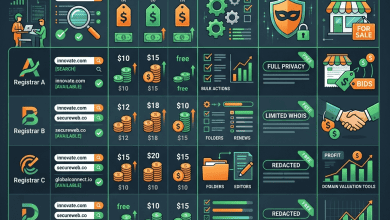
Domain extension pricing varies significantly across TLDs and registrars. General pricing tiers include: budget extensions (.xyz, .online, .site) at $1-10 per year; standard extensions (.com, .net, .org) at $8-15 per year; premium extensions (.io, .co, .ai) at $25-80 per year; and specialty extensions (some new gTLDs) at variable pricing. Renewal pricing should be carefully checked, as some extensions offer very low first-year pricing with significantly higher renewal rates.
Trademark Considerations
Domain extension selection intersects with trademark law in important ways. Registering a domain containing another company’s trademark u2014 regardless of the TLD u2014 may constitute trademark infringement or cybersquatting under the Uniform Domain-Name Dispute-Resolution Policy (UDRP). Before registering any domain, buyers should verify that the domain name does not infringe on existing trademarks in their target markets. The UDRP provides a dispute resolution mechanism that trademark holders can use to recover domains registered in bad faith, which applies equally across all TLDs including .com, .io, new gTLDs, and country-code extensions.
Decision Framework
Choose .com if: the desired .com name is available or affordable; the website targets general consumer audiences; maximum trust and recognition are important; or the domain will be shared verbally (where .com is assumed by default). Choose .io/.dev/.app if: the product targets technology audiences; the desired .com is unavailable; the brand benefits from technology-associated positioning; or built-in HTTPS is valued (.dev, .app). Choose country-code TLDs if: the business serves a specific national market; local search visibility is prioritized; or local brand identity is important. Choose new gTLDs if: descriptive domain naming is valued; budget constraints favor affordable extensions; or creative branding opportunities outweigh recognition trade-offs.
Summary
Domain extension selection balances recognition, trust, availability, pricing, and branding requirements. While .com remains the universal standard for maximum recognition and trust, alternative extensions provide viable and increasingly accepted options for specific use cases. The optimal TLD choice depends on target audience familiarity, brand positioning strategy, budget considerations, and the practical availability of desired domain names across different extensions. Regardless of TLD choice, building quality content, strong user experience, and legitimate domain authority ultimately determines long-term online success more than the specific extension used.
Information discussed in this guide reflects general industry knowledge at the time of writing. Domain pricing, availability, and policies change frequently. Please verify current details on registrar websites. Okut Hosting is an independent review platform with no affiliate relationships with any company mentioned in this article.
For related guides, see our GoDaddy vs Namecheap comparison, our country-code domains guide, and our DNS management basics.