KeyCDN is a content delivery network provider based in Switzerland that has established a strong reputation for delivering reliable CDN services at competitive pay-per-use pricing. Founded in 2012, KeyCDN focuses on providing straightforward content delivery with transparent pricing, a clean management interface, and solid global coverage. The platform serves websites, applications, and digital services of all sizes, from individual blogs to high-traffic commercial websites, with a particular appeal to cost-conscious users who need professional CDN performance without enterprise-level pricing commitments.
This review examines KeyCDN’s infrastructure, performance characteristics, pricing model, feature set, WordPress integration, security capabilities, and competitive positioning. The analysis provides neutral evaluation to help website owners assess whether KeyCDN’s combination of affordability and performance aligns with their content delivery requirements.
Global Network Infrastructure
KeyCDN operates a network of data centers distributed across strategic locations in North America, Europe, Asia-Pacific, South America, and Oceania. The network provides broad geographic coverage that ensures reasonable proximity between edge servers and visitors in major internet markets worldwide. KeyCDN’s Points of Presence (PoPs) are positioned in key metropolitan areas and internet exchange points, optimizing routing efficiency for content delivery to end users.
The network infrastructure supports HTTP/2 by default, enabling multiplexed connections, header compression, and server push capabilities that improve page load performance compared to HTTP/1.1 connections. IPv6 support ensures compatibility with modern network infrastructure, and the network’s peering relationships with major internet service providers optimize traffic routing for consistent performance.
Pay-Per-Use Pricing
KeyCDN’s pricing model is based on bandwidth consumption with per-GB rates that vary by geographic region. North American and European traffic is priced at the lowest rates, with Asia-Pacific, South American, and other regions priced at higher per-GB rates reflecting the infrastructure costs in those areas. The pricing structure includes no monthly minimum commitments, making KeyCDN accessible for websites with low or variable traffic volumes.
A minimum credit purchase ($49) is required to start, which provides credit that is consumed based on actual bandwidth usage. This prepaid credit model eliminates monthly billing complexity and ensures that costs directly correspond to actual CDN usage. For websites with moderate traffic, the initial credit can last several months, making KeyCDN one of the most cost-effective CDN options available. The transparent per-GB pricing enables accurate cost projection based on expected traffic volumes.
Compared to Cloudflare’s free tier, KeyCDN requires payment from the first byte of traffic. However, compared to other paid CDN services, KeyCDN’s per-GB rates are consistently competitive, particularly for websites with traffic concentrated in North America and Europe where the lowest rates apply.
Pull Zone Configuration
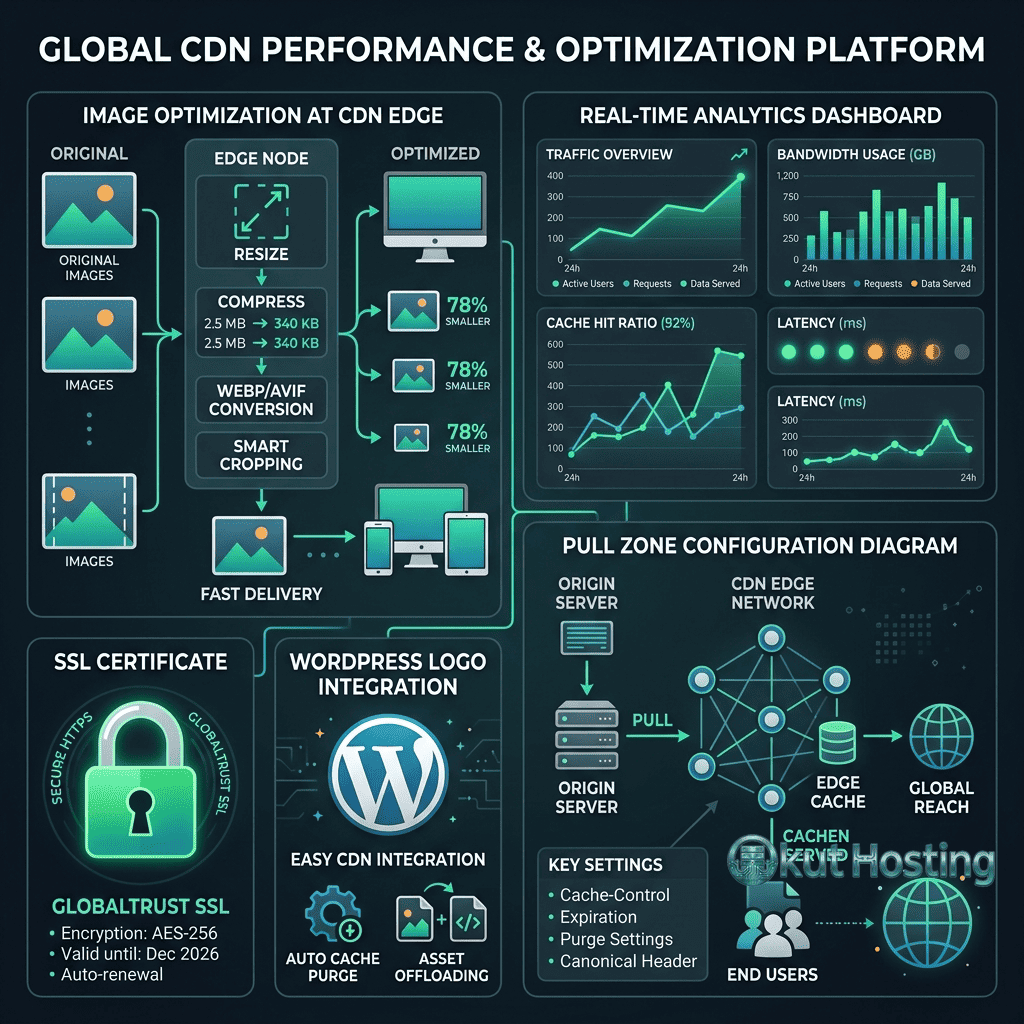
KeyCDN uses a pull zone model where edge servers automatically fetch and cache content from the origin server when requested by visitors. Pull zone configuration involves specifying the origin server URL, configuring caching rules, and setting up a custom CDN hostname (cdn.example.com). Once configured, static assets (images, CSS, JavaScript, fonts, videos) are served from KeyCDN’s edge servers, reducing load on the origin server and improving delivery speed for visitors worldwide.
Multiple pull zones can be created for different purposes — separating image delivery from JavaScript delivery, or configuring different caching rules for different content types. Each pull zone operates independently with its own configuration, caching rules, and analytics, enabling granular control over content delivery behavior for different asset categories.
Push Zone and Storage
In addition to pull zones, KeyCDN provides push zones that function as edge storage for hosting static files directly on CDN infrastructure. Push zones accept file uploads through FTP, rsync, or the KeyCDN API, storing files on KeyCDN’s infrastructure for direct edge delivery without requiring an origin server. Push zones are useful for: hosting static websites directly on CDN infrastructure; distributing large file downloads (software, media, documents); and serving assets that don’t require dynamic origin server generation.
Image Processing
KeyCDN includes an image processing engine that performs on-the-fly image manipulation at the edge. Supported operations include resizing, cropping, rotation, quality adjustment, format conversion (including WebP generation), and visual effects. Image processing is triggered through URL parameters appended to image requests, enabling dynamic image transformation without pre-generating multiple variants. This feature is particularly valuable for responsive web design where different image sizes are needed for different screen sizes and device types.
The image processing engine reduces bandwidth consumption by serving optimally sized and compressed images to each visitor, while eliminating the storage and management overhead of maintaining multiple pre-generated image variants. For image-heavy websites including e-commerce stores, portfolios, and media sites, KeyCDN’s built-in image processing provides meaningful performance and workflow improvements.
WordPress Integration
KeyCDN integrates with WordPress through CDN integration plugins including CDN Enabler (KeyCDN’s own lightweight plugin), W3 Total Cache, WP Super Cache, and other popular caching plugins. CDN Enabler rewrites static asset URLs to use the KeyCDN hostname, directing browsers to fetch images, CSS, JavaScript, and other static files from KeyCDN’s edge servers rather than the origin WordPress server.
The integration process involves: creating a pull zone in KeyCDN’s dashboard with the WordPress site as the origin; configuring a custom CDN hostname through DNS (CNAME record); installing and configuring CDN Enabler or another integration plugin; and optionally enabling image processing for automatic optimization. The straightforward integration makes KeyCDN accessible for WordPress users without extensive technical expertise.
Security Features
KeyCDN provides essential security features for content delivery protection. Free SSL certificates through Let’s Encrypt are automatically provisioned for custom CDN hostnames, ensuring encrypted content delivery. Additional security features include: HTTP/2 with TLS encryption; hotlink protection preventing unauthorized embedding of CDN-hosted content; token-based URL authentication for restricting content access; IP blacklisting and whitelisting; and basic DDoS mitigation at the network level.
While KeyCDN’s security features are adequate for content delivery protection, they do not include the comprehensive Web Application Firewall (WAF), advanced bot management, or enterprise-grade DDoS protection offered by security-focused CDN platforms like Cloudflare or Fastly. Websites requiring advanced security beyond content delivery protection should consider supplementing KeyCDN with dedicated security services.
Real-Time Analytics
KeyCDN provides real-time analytics with detailed visibility into CDN performance and usage. Analytics metrics include: bandwidth consumption by zone and time period; request counts and cache hit ratios; geographic traffic distribution showing visitor locations; HTTP status code distribution identifying errors; and popular content tracking showing most-requested assets. The analytics dashboard provides both real-time monitoring and historical data analysis, enabling identification of traffic patterns, performance issues, and optimization opportunities.
HTTP/2 and Performance Optimization
KeyCDN supports HTTP/2 by default on all pull zones, enabling multiplexed connections that load multiple assets over a single TCP connection, header compression that reduces overhead for repeated requests, and server push for proactively delivering assets before they are explicitly requested. These HTTP/2 features provide measurable performance improvements over HTTP/1.1 connections, particularly for pages with many static assets.
Additional performance optimization features include: Brotli and Gzip compression for text-based assets (HTML, CSS, JavaScript); configurable cache expiration headers; query string caching control; and edge caching rules based on file type, URL pattern, or custom headers. These optimization tools enable fine-tuning content delivery performance for specific website requirements.
API Access
KeyCDN provides a comprehensive REST API for programmatic management of zones, cache operations, analytics, and account settings. The API enables automation of CDN operations including: zone creation and configuration; cache purging (by URL, by tag, or full zone purge); analytics data retrieval for custom dashboards; and integration with CI/CD pipelines for automated deployment workflows. API documentation includes detailed endpoint descriptions, authentication procedures, and code examples for common operations.
Origin Shield
KeyCDN’s origin shield feature routes cache fill requests through a designated edge location before reaching the origin server, consolidating requests and reducing origin server load. Origin shield is particularly beneficial for: origin servers with limited capacity; websites experiencing traffic spikes; and configurations where minimizing origin load is critical for performance or cost reasons. The shield location can be configured based on the origin server’s geographic position to minimize latency between the shield and the origin.
Custom SSL and Domain Configuration
KeyCDN supports custom SSL certificates alongside the automatic Let’s Encrypt certificates, enabling organizations with specific certificate requirements to use their own certificates for CDN delivery. Custom domain configuration through CNAME DNS records enables branded CDN hostnames (cdn.example.com) that maintain visual consistency with the primary domain. Shared SSL using KeyCDN’s domain is available for simpler configurations that don’t require custom hostnames.
Content Optimization
Beyond image processing, KeyCDN provides content optimization features including: automatic minification of CSS and JavaScript files to reduce file sizes; WebP image format support for browsers that accept WebP; configurable compression levels for different content types; and cache key customization for optimizing cache efficiency. These optimization features complement the CDN’s delivery speed with reduced file sizes, further improving page load times for end users.
Swiss Data Privacy
KeyCDN’s Swiss headquarters provides a favorable data privacy jurisdiction. Switzerland maintains some of the strongest data protection laws globally, and Swiss Federal Data Protection Act (FADP) compliance provides privacy assurances for data processed through KeyCDN’s infrastructure. For organizations with data privacy concerns, KeyCDN’s Swiss jurisdiction and GDPR compliance provide privacy-protective content delivery infrastructure. This privacy positioning distinguishes KeyCDN from CDN providers based in jurisdictions with less protective data privacy frameworks.
Zone Referrer Protection
KeyCDN’s zone referrer feature enables restricting which domains can embed or reference CDN-hosted content. By specifying allowed referrer domains, website owners prevent unauthorized third-party websites from hotlinking images, videos, and other assets hosted on KeyCDN, which would consume bandwidth without benefit to the content owner. Referrer protection is configured per zone and supports both whitelist (only specified domains allowed) and blacklist (specific domains blocked) modes. This feature is essential for protecting bandwidth allocation and preventing unauthorized content usage.
Cache Management and Purging
KeyCDN provides flexible cache management through multiple purging mechanisms. URL-based purging clears specific cached assets; tag-based purging invalidates groups of related assets sharing a common tag; and zone purging clears the entire cache for a specific zone. Cache purging is accessible through both the KeyCDN dashboard and the REST API, enabling manual and automated cache management. The purge propagation time across KeyCDN’s network is typically completed within seconds, ensuring that updated content reaches visitors promptly after origin changes.
Cache management best practices with KeyCDN include: using appropriate cache expiration headers on the origin server; implementing cache busting through filename versioning for frequently updated assets; leveraging tag-based purging for efficient selective cache invalidation; and monitoring cache hit ratios through analytics to identify caching optimization opportunities.
Raw Log Forwarding
KeyCDN provides raw log forwarding that streams detailed access logs to external storage destinations for analysis, compliance, and monitoring purposes. Log forwarding supports delivery to Amazon S3, Google Cloud Storage, and custom HTTP endpoints. Raw logs contain detailed per-request data including visitor IP addresses, request URLs, response codes, bandwidth consumption, cache status, and timing information. This data enables advanced traffic analysis, security monitoring, and custom reporting beyond KeyCDN’s built-in analytics capabilities.
Instant SSL Deployment
SSL certificate deployment for custom CDN hostnames is automated through Let’s Encrypt integration, with certificates provisioned and renewed automatically without manual intervention. The automated SSL process eliminates certificate management overhead while ensuring that all CDN-delivered content is served over encrypted HTTPS connections. Certificate provisioning typically completes within minutes of DNS configuration, enabling rapid deployment of secure CDN hostnames.
Edge Rules
KeyCDN’s edge rules engine enables custom logic execution at edge locations without modifying origin server configuration. Edge rules support conditions based on URL patterns, request headers, geographic location, device type, and other request attributes. Actions include header modification, URL rewriting, access control, and caching behavior customization. Edge rules provide a lightweight alternative to server-side logic for common CDN configuration needs, enabling customized content delivery behavior without origin server changes.
Monitoring and Uptime
KeyCDN maintains a public status page providing real-time network status visibility across all Points of Presence. Historical uptime data demonstrates KeyCDN’s reliability track record. For websites that depend on CDN availability for content delivery, monitoring CDN status alongside origin server monitoring provides comprehensive infrastructure visibility. KeyCDN’s uptime record and transparent status reporting enable informed assessments of service reliability for production deployment decisions.
Migration to and from KeyCDN
Migrating to KeyCDN from another CDN provider involves creating pull zones, configuring DNS CNAME records, and updating any CDN-specific URLs in website templates or plugins. Since KeyCDN uses standard CDN integration patterns (CNAME-based custom hostnames), migration from other pull-based CDNs is straightforward. Migrating away from KeyCDN follows the reverse process. The standard integration approach ensures that KeyCDN does not create vendor lock-in, enabling flexible CDN provider selection based on evolving needs.
Comparison with Competitors
Compared to Cloudflare, KeyCDN provides competitive pay-per-use pricing and built-in image processing, while Cloudflare provides a free tier, comprehensive security platform, DNS hosting, and a larger edge network. Compared to BunnyCDN, KeyCDN provides similar pay-per-use pricing with built-in image processing capabilities, while BunnyCDN provides video delivery services and a slightly larger network. Compared to Fastly, KeyCDN provides simpler configuration and lower pricing, while Fastly provides instant purge, edge computing, and enterprise-grade capabilities.
Customer Support
KeyCDN provides email-based customer support with a reputation for knowledgeable and responsive assistance. The support team handles technical configuration questions, troubleshooting, and account management inquiries. A comprehensive knowledge base provides self-service documentation covering setup guides, configuration tutorials, troubleshooting procedures, and integration instructions. Community forums and developer documentation supplement the direct support channels. While KeyCDN does not provide phone support or 24/7 live chat, the email support quality and knowledge base comprehensiveness are generally well-regarded by users.
Ideal Use Cases
KeyCDN is particularly well-suited for: WordPress websites needing affordable CDN with built-in image processing; small to medium businesses seeking professional CDN without enterprise pricing; development teams requiring API-driven CDN management; websites with variable traffic that benefit from pay-per-use pricing without monthly minimums; and privacy-conscious organizations that value Swiss data protection jurisdiction. The platform provides the best value proposition for websites that need reliable content delivery and image optimization at the lowest possible cost point.
Limitations
KeyCDN’s limitations include: no free tier (minimum $49 credit purchase required); no built-in WAF or advanced security features; no edge computing or serverless functionality; smaller network footprint compared to Cloudflare, Akamai, or Amazon CloudFront; and no integrated DNS hosting. These limitations reflect KeyCDN’s focused positioning as a cost-effective CDN rather than a comprehensive internet platform.
Summary
KeyCDN delivers reliable content delivery with competitive pay-per-use pricing, built-in image processing, solid WordPress integration, and Swiss data privacy protection. The platform excels for cost-conscious website owners who need professional CDN performance without monthly commitments, enterprise complexity, or security feature overhead. For websites requiring straightforward content delivery with transparent pricing and effective performance optimization, KeyCDN provides an accessible and cost-effective solution that scales from small websites to high-traffic commercial operations.
Features, pricing, and availability discussed in this review reflect information available at the time of writing. Please verify current details on the official KeyCDN website. Okut Hosting is an independent review platform with no affiliate relationships with any company mentioned in this article.
For related reviews, see our Cloudflare vs BunnyCDN comparison, our Amazon CloudFront review, and our image optimization guide.