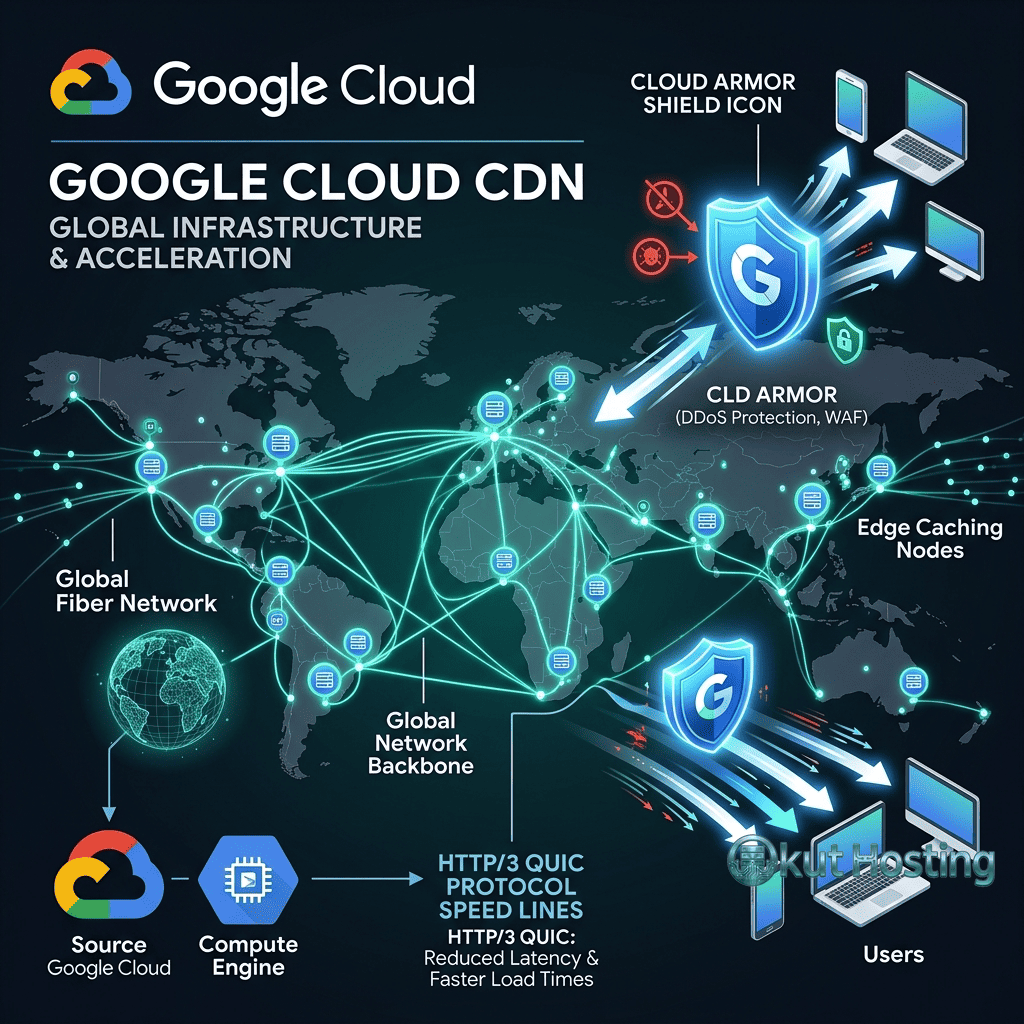
Google Cloud CDN is Google Cloud Platform’s content delivery network service that leverages Google’s massive global infrastructure — the same network that powers Google Search, YouTube, Gmail, and other Google services — to deliver web content, APIs, and media with low latency worldwide. Google Cloud CDN operates through Google’s extensive network of edge caching locations, which are positioned within Google’s global network infrastructure spanning over 200 countries and territories.
This overview examines Google Cloud CDN’s infrastructure, features, pricing, security integration through Cloud Armor, Media CDN for large-scale media delivery, WordPress compatibility, and competitive positioning within the CDN market. The analysis provides neutral evaluation for organizations assessing Google Cloud CDN as their content delivery solution.
Google’s Global Network
Google Cloud CDN leverages Google’s private global network, which connects data centers and edge locations through one of the largest private fiber networks in the world. Google’s network infrastructure includes subsea cables, terrestrial fiber, and peering arrangements that provide direct connectivity to internet service providers globally. Content cached by Cloud CDN is served from edge locations within Google’s network, benefiting from the same low-latency, high-bandwidth infrastructure that serves Google’s own products to billions of users.
The network’s scale provides inherent advantages: massive capacity for handling traffic spikes without performance degradation; optimized routing through Google’s private backbone rather than the public internet; and edge locations positioned for optimal proximity to end users in major markets worldwide. This infrastructure investment, primarily built for Google’s own services, provides Cloud CDN customers with network capabilities that would be prohibitively expensive to build independently.
Cloud CDN Features
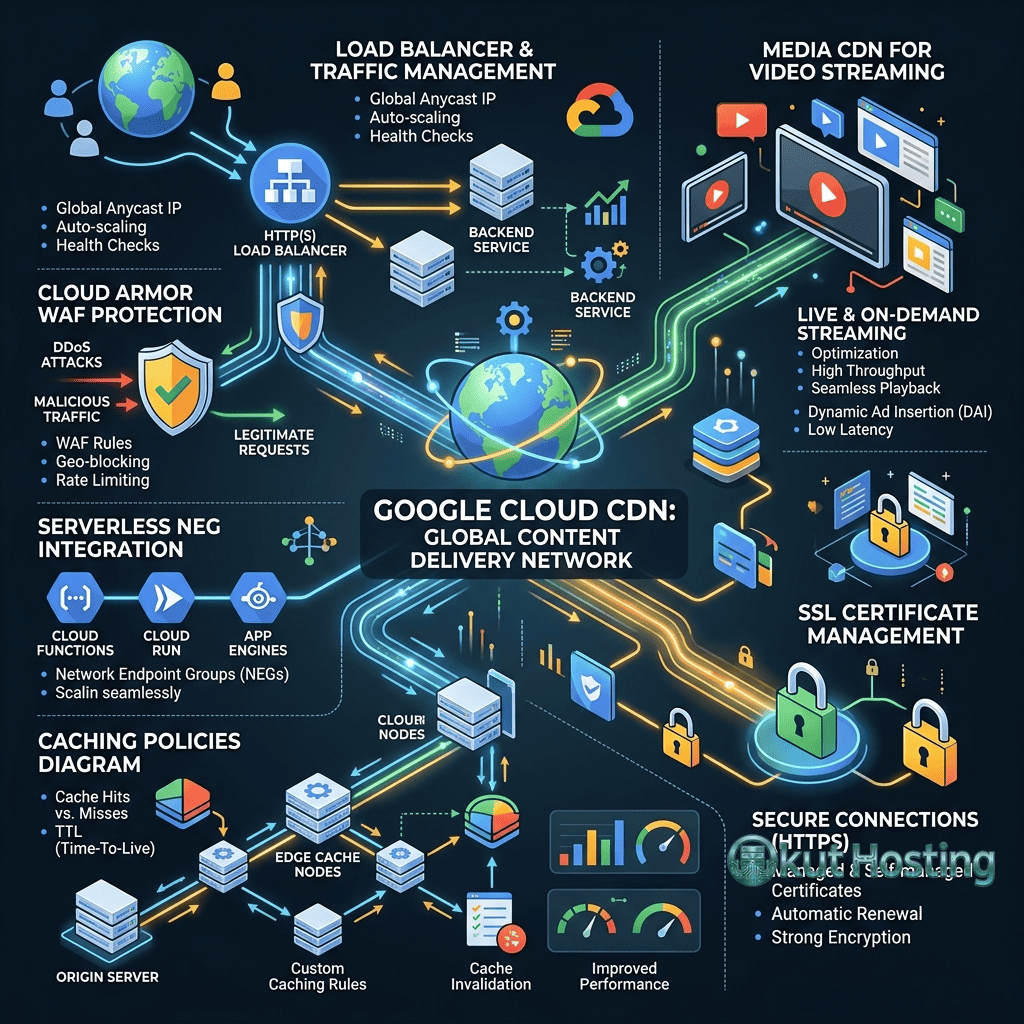
Google Cloud CDN provides core content delivery features including: HTTP/2 and HTTP/3 (QUIC) support for modern protocol performance; Anycast IP addressing for automatic geographic routing; global external Application Load Balancer integration; cache invalidation through URL and tag-based purging; signed URLs and signed cookies for content access control; and custom response headers for cache control and security. These features provide the fundamental CDN capabilities needed for accelerating web content delivery.
Integration with Google Cloud Platform
Cloud CDN integrates deeply with GCP services, creating a cohesive infrastructure stack. Key integrations include: Cloud Load Balancing (global HTTP/S load balancer serves as the entry point for Cloud CDN); Compute Engine and GKE (virtual machines and Kubernetes clusters as CDN origins); Cloud Storage (object storage serving as a CDN origin for static assets); Cloud Armor (web application firewall and DDoS protection); Cloud Logging and Monitoring (comprehensive visibility into CDN operations); and Cloud CDN cache policies (configurable through GCP’s unified management interface).
For organizations already using Google Cloud Platform for hosting and application infrastructure, Cloud CDN provides seamless integration that eliminates the complexity of connecting third-party CDN services to GCP resources. The unified billing, management interface, IAM (Identity and Access Management), and monitoring reduce operational overhead compared to managing separate CDN and cloud infrastructure providers.
Media CDN
Google Cloud’s Media CDN is a specialized content delivery service designed for large-scale media delivery, built on the same infrastructure that delivers YouTube content globally. Media CDN provides: high-throughput delivery optimized for large media files; HTTP/3 (QUIC) support for improved streaming performance; advanced caching with long-tail content optimization; origin shielding to reduce origin load; token-based authentication for content protection; and detailed media analytics. Media CDN is designed for media companies, streaming services, and organizations with large-scale video and media delivery requirements that exceed standard CDN capabilities.
Cloud Armor Security
Cloud Armor provides web application firewall (WAF) and DDoS protection that integrates directly with Cloud CDN through the global Application Load Balancer. Cloud Armor features include: preconfigured WAF rules based on OWASP ModSecurity Core Rule Set; custom security policies using Cloud Armor’s rule language; adaptive protection using machine learning to detect and mitigate attacks; rate limiting for API and login protection; geographic access control for content restriction by country; and bot management capabilities. Cloud Armor’s integration with Cloud CDN provides security enforcement at the edge before requests reach origin servers.
Caching Policies
Cloud CDN supports configurable caching policies that control caching behavior based on content type, URL patterns, and origin response headers. Cache modes include: USE_ORIGIN_HEADERS (respects Cache-Control headers from the origin); CACHE_ALL_STATIC (caches static content regardless of origin headers); and FORCE_CACHE_ALL (caches all content with configurable TTL). Cache key configuration enables controlling which request attributes (query parameters, headers, cookies) are included in cache key generation, optimizing cache hit ratios for specific application patterns.
SSL/TLS Management
Cloud CDN provides SSL/TLS encryption through Google-managed certificates that are automatically provisioned and renewed for custom domains. Google-managed certificates use domain validation and support both RSA and ECDSA key types. Self-managed certificates can also be uploaded for organizations with specific certificate requirements. TLS 1.3 support is enabled by default, providing the latest encryption standards. The certificate management integration through GCP eliminates manual certificate renewal processes.
Pricing
Cloud CDN pricing is based on: cache egress (data served from cache to clients, per GB with regional pricing); cache fill (data fetched from origin to cache, per GB); cache lookup requests (per 10,000 requests); and cache invalidation requests. Pricing varies by geographic region, with North America and Europe priced lowest. Sustained use discounts automatically reduce per-GB costs as monthly volume increases. Committed use discounts provide additional savings for organizations with predictable high-volume traffic.
Compared to Cloudflare’s free tier, Cloud CDN requires payment from the first request. However, for GCP-hosted origins, Cloud CDN eliminates external data transfer costs that would apply when using a third-party CDN, potentially reducing total infrastructure costs. The cost comparison depends on origin hosting location, traffic volume, and geographic distribution.
Origin Health Checks
Cloud CDN works with Google Cloud’s health check system to monitor origin server availability. Health checks continuously verify that origin servers are responsive, automatically routing traffic away from unhealthy origins in multi-origin configurations. Health check parameters (check interval, timeout, healthy/unhealthy thresholds) are configurable to match the origin’s operational characteristics. This automated health monitoring ensures that CDN traffic is always routed to functional origin servers without manual intervention.
Custom Headers and Request Manipulation
Cloud CDN supports custom request and response headers that enable additional functionality including: adding security headers (Content-Security-Policy, X-Frame-Options, Strict-Transport-Security) at the edge; inserting custom headers for origin server processing; removing headers from responses for security or privacy; and adding cache-related headers for debugging. Custom header configuration is managed through backend service settings, enabling consistent header policies across all CDN-delivered content.
Negative Caching
Cloud CDN supports negative caching, which caches error responses (404, 500, etc.) to prevent repeated origin requests for content that consistently returns errors. Negative caching reduces origin server load from repeated requests for non-existent content (broken links, removed pages) and protects origin servers from amplified load during error conditions. The negative caching TTL is configurable, enabling appropriate freshness for error responses that may become valid after content updates or server recovery.
Cloud CDN with Cloud Interconnect
Organizations using Cloud Interconnect (dedicated network connections to Google Cloud) benefit from optimized origin-to-CDN communication through private network paths rather than the public internet. Cloud Interconnect provides consistent, low-latency connectivity between on-premises data centers and Google Cloud, which extends to Cloud CDN origin fetch operations. For hybrid architectures where origin servers reside in on-premises data centers, Cloud Interconnect ensures that CDN cache fill operations use reliable, high-bandwidth private connections.
Content-Based Routing
Cloud CDN’s URL map configuration enables content-based routing that directs different request paths to different backend services. For example, /images/* requests can be routed to a Cloud Storage bucket optimized for image delivery, while /api/* requests are routed to a Compute Engine backend optimized for dynamic API responses. This content-based routing enables mixed-content architectures where static and dynamic content are served from optimized backends while sharing a single CDN distribution and domain.
Compliance and Data Residency
Google Cloud CDN operates within Google Cloud’s compliance framework, which includes SOC 1/2/3, PCI DSS, ISO 27001, ISO 27017, ISO 27018, HIPAA, and FedRAMP certifications. For organizations with data residency requirements, Cloud CDN’s caching behavior can be considered within Google Cloud’s regional compliance commitments. Google Cloud’s compliance documentation provides detailed information about data handling, processing locations, and privacy protections for CDN-cached content.
Edge Storage and Caching Tiers
Cloud CDN uses a multi-tier caching architecture with edge locations and regional mid-tier caches. Edge locations serve content directly to end users, while regional mid-tier caches maintain copies of less frequently accessed content that might be evicted from edge caches. This tiered architecture improves cache hit ratios for long-tail content (content accessed infrequently but still benefiting from caching) without requiring larger edge caches at every location. The tiered caching operates transparently without configuration, automatically optimizing cache placement across the network.
API and Terraform Management
Cloud CDN configuration is manageable through the GCP Console, gcloud CLI, REST API, and Terraform. Terraform provider support enables infrastructure-as-code management of Cloud CDN configurations alongside other GCP resources, providing version-controlled, reproducible CDN configurations. The API enables programmatic management including cache invalidation, configuration updates, and monitoring integration. For organizations practicing DevOps and infrastructure automation, Cloud CDN’s management interfaces integrate naturally with GCP’s unified API ecosystem.
Performance Benchmarks
Google Cloud CDN benefits from Google’s premium tier networking, which routes traffic through Google’s private backbone for optimal performance. Benchmarks consistently show competitive TTFB (Time to First Byte) and throughput metrics, with particularly strong performance for users in regions with dense Google network presence. The combination of HTTP/3 QUIC support, Anycast routing, and private backbone infrastructure provides performance advantages that are difficult to replicate without equivalent network investment.
Cost Management
Cloud CDN cost management is integrated with Google Cloud’s billing and cost management tools. Budget alerts, billing exports, and cost analysis dashboards provide visibility into CDN spending alongside other GCP services. For organizations using GCP billing tools, CDN costs are tracked within the unified billing infrastructure, simplifying financial management and cost attribution across teams and projects. Committed use discounts and sustained use pricing automatically reduce per-unit costs as usage increases.
Cache Invalidation
Cloud CDN supports cache invalidation through URL path patterns, enabling purging specific content or groups of related content when updates are needed. Invalidation requests propagate across all edge locations, ensuring consistent content freshness globally. While Cloud CDN does not provide the sub-second purge speeds of Fastly, invalidation typically completes within minutes. For applications requiring faster content updates, implementing cache-busting through URL versioning provides immediate freshness without relying on invalidation propagation.
Logging and Monitoring
Cloud CDN integrates with Cloud Logging for detailed request-level logging and Cloud Monitoring for metrics and alerting. Logging captures per-request data including cache hit/miss status, response codes, latency, and client information. Cloud Monitoring provides dashboards and alerts for key CDN metrics including cache hit ratio, bandwidth, request rates, and error rates. The integrated monitoring enables unified infrastructure visibility across compute, storage, networking, and CDN services within the GCP console.
WordPress Compatibility
Cloud CDN is compatible with WordPress through standard CDN integration methods. WordPress sites hosted on GCP (Compute Engine, GKE, or Cloud Run) can use Cloud CDN through the global Application Load Balancer for seamless integration. For WordPress sites hosted outside GCP, Cloud CDN can be configured with custom origins. WordPress caching plugins manage origin-level caching while Cloud CDN handles edge caching, providing a two-layer caching architecture that optimizes performance for WordPress sites.
HTTP/3 and QUIC Support
Cloud CDN supports HTTP/3 with QUIC (Quick UDP Internet Connections), Google’s transport protocol that provides improved performance over traditional TCP connections. QUIC benefits include: faster connection establishment (0-RTT handshakes); better performance on lossy networks (mobile, WiFi); connection migration that maintains sessions during network changes; and improved multiplexing without head-of-line blocking. HTTP/3 support is enabled by default, providing automatic performance benefits for clients that support the protocol.
Serverless NEG Integration
Cloud CDN supports serverless network endpoint groups (NEGs) that enable caching content from serverless backends including Cloud Run, Cloud Functions, and App Engine. This integration enables serverless applications to benefit from edge caching without traditional server infrastructure. Serverless NEG integration is particularly valuable for API caching, server-side rendered pages, and dynamic content that benefits from edge caching but is generated by serverless functions.
Getting Started with Cloud CDN
Enabling Cloud CDN requires: creating a global external Application Load Balancer; configuring backend services with origin servers (Compute Engine instances, GKE services, Cloud Storage buckets, or external backends); enabling Cloud CDN on the backend service configuration; and optionally configuring caching policies, Cloud Armor security policies, and custom headers. Google Cloud provides quickstart guides and tutorials for common Cloud CDN configurations, and new GCP accounts receive free trial credits that can be used for Cloud CDN testing.
Limitations
Cloud CDN’s limitations include: tight coupling with Google Cloud Platform (most effective for GCP-hosted origins); requirement for global external Application Load Balancer (adding configuration complexity); no standalone CDN option independent of GCP infrastructure; no free tier beyond the initial GCP trial credits; and less extensive edge computing capabilities compared to Cloudflare Workers or Fastly Compute@Edge. These limitations reflect Cloud CDN’s positioning as a GCP-native service rather than a standalone CDN product, which benefits GCP users but may not suit organizations using other cloud providers.
Multi-CDN Strategy with Cloud CDN
Organizations implementing multi-CDN strategies can include Cloud CDN alongside other CDN providers for redundancy and geographic optimization. DNS-based traffic management routes requests to the optimal CDN based on performance, availability, or geographic factors. Cloud CDN’s standard integration through DNS and HTTP ensures compatibility with multi-CDN traffic management solutions. For GCP-hosted origins, Cloud CDN provides optimal performance due to private backbone connectivity, while secondary CDN providers handle failover or geographic regions where alternative providers may perform better.
Comparison with Competitors
Compared to Amazon CloudFront, Google Cloud CDN provides equivalent GCP integration (as CloudFront provides AWS integration), with Google’s superior network infrastructure and QUIC support, while CloudFront provides more edge computing options (Lambda@Edge, CloudFront Functions) and a larger dedicated CDN network. Compared to Cloudflare, Cloud CDN provides tighter GCP integration and access to Google’s network, while Cloudflare provides a free tier, simpler configuration, and a larger CDN network. Compared to Akamai, Cloud CDN provides modern cloud-native architecture and transparent pricing, while Akamai provides the largest dedicated CDN network and deepest enterprise services.
Summary
Google Cloud CDN provides content delivery powered by Google’s world-class global network infrastructure, offering low-latency content delivery, comprehensive GCP integration, Cloud Armor security, and modern protocol support including HTTP/3 with QUIC. The platform excels for organizations using Google Cloud Platform as their primary cloud infrastructure, applications requiring Google’s network performance advantages, and media delivery through the specialized Media CDN service. While the platform’s GCP-centric design may not suit organizations using other cloud providers, the combination of Google’s network infrastructure and CDN capabilities provides compelling performance for GCP-hosted applications.
Features, pricing, and availability discussed in this overview reflect information available at the time of writing. Please verify current details on the official Google Cloud CDN website. Okut Hosting is an independent review platform with no affiliate relationships with any company mentioned in this article.
For related reviews, see our Amazon CloudFront review, our Cloudflare vs BunnyCDN comparison, and our Core Web Vitals guide.