Bluehost and HostGator are two of the most widely recognized names in the shared hosting market, both operating under the Newfold Digital umbrella (formerly Endurance International Group). Despite shared corporate ownership, these brands maintain distinct product lines, pricing strategies, and brand identities that target overlapping but subtly different segments of the web hosting market. Understanding how these two platforms compare across infrastructure, pricing, features, and support helps hosting buyers make informed decisions when choosing between two of the industry’s most established shared hosting providers.
Both providers have been operating since the early 2000s — Bluehost was founded in 2003 in Provo, Utah, while HostGator was founded in 2002 in Houston, Texas. Over two decades of operation have given both brands extensive experience with the shared hosting model, large customer bases, and the infrastructure to support millions of websites. However, longevity alone does not determine hosting quality, and the technical details of each provider’s current offerings matter more than historical reputation. This comparison examines the current state of both platforms across the factors that matter most for shared hosting buyers.
Plan Structure and Pricing
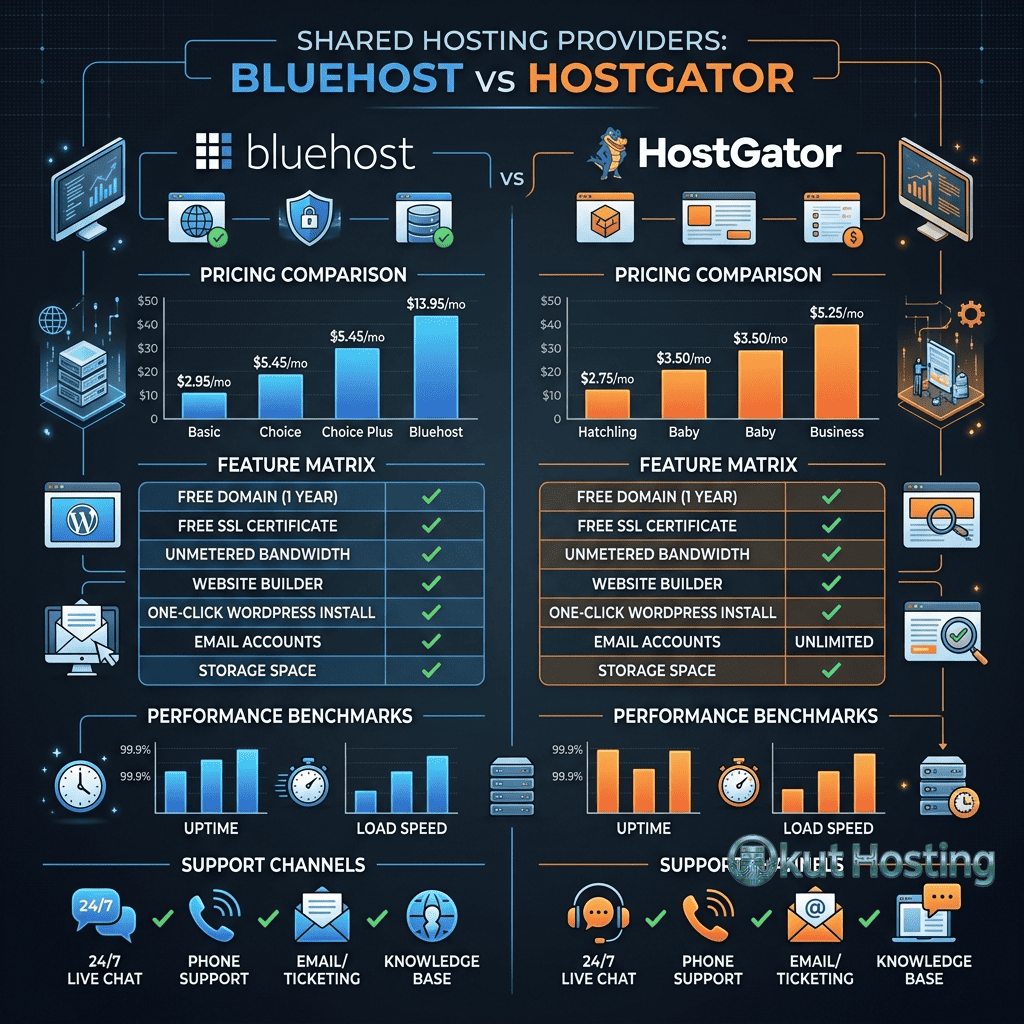
Bluehost structures its shared hosting across four tiers: Basic, Plus, Choice Plus, and Online Store. The Basic plan supports a single website with 10 GB of SSD storage and a free domain for the first year. The Plus plan removes the site limit and increases storage to unmetered SSD space. Choice Plus adds automated backups through CodeGuard and domain privacy. The Online Store plan adds WooCommerce-specific features for e-commerce functionality. Each tier represents a meaningful feature upgrade rather than merely increasing resource allocations.
HostGator organizes its shared hosting into three tiers: Hatchling, Baby, and Business. The Hatchling plan supports a single website with unmetered bandwidth and storage. The Baby plan adds support for unlimited domains. The Business plan includes a free dedicated IP address, free SSL upgrade, and free SEO tools. HostGator’s tier progression focuses on expanding capabilities rather than increasing performance specifications, with the distinction between tiers primarily around domain limits and business features.
Both providers use promotional pricing that offers significant discounts on initial terms, with regular pricing applying upon renewal. The promotional-to-renewal price increase is substantial for both brands — often two to three times the initial price — making it essential to evaluate renewal pricing when comparing long-term costs. Both providers offer their deepest discounts on the longest term commitments (typically 36-month plans), creating an incentive structure that favors long-term commitments at the cost of flexibility.
When comparing equivalent tiers, Bluehost and HostGator pricing is competitive with each other, with promotional prices typically within a few dollars per month of each other for comparable feature sets. The cost difference between the two providers is generally not large enough to be a deciding factor — feature differences, support quality, and interface preferences are more meaningful differentiators than the modest pricing gap between equivalent plans.
Server Infrastructure
Both Bluehost and HostGator operate on infrastructure managed by Newfold Digital, sharing some underlying data center resources and network infrastructure. However, the two brands implement different server configurations, control panels, and optimization approaches that create distinct hosting experiences despite the shared corporate infrastructure.
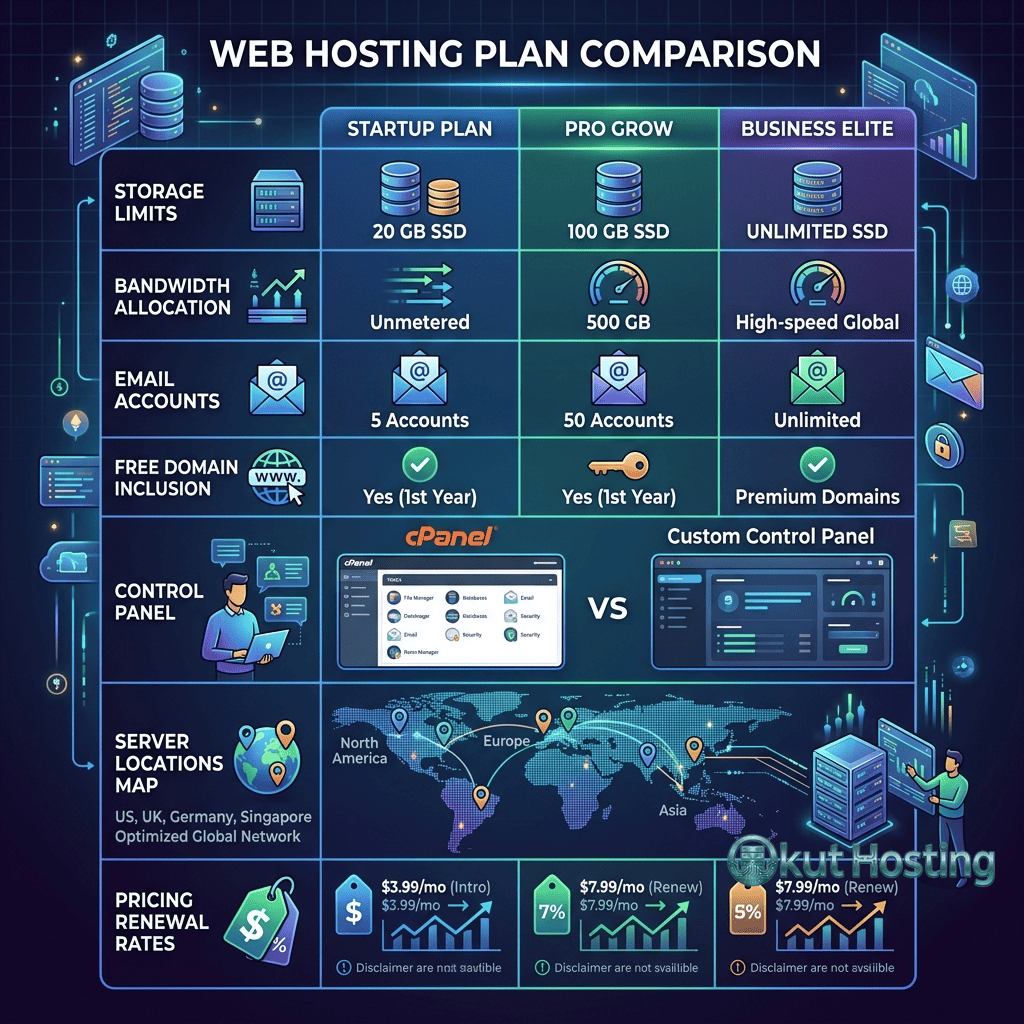
Bluehost has invested in custom dashboard development, providing a modified cPanel experience with additional Bluehost-specific tools and a more modern interface design. The Bluehost dashboard integrates WordPress management tools, marketplace plugins, and hosting management in a unified interface designed to simplify the hosting experience for WordPress-focused users. PHP version management, SSL configuration, and domain management are accessible through this custom interface.
HostGator provides a more traditional cPanel hosting experience with fewer customizations, maintaining the standard cPanel interface that experienced hosting users are familiar with. The standard cPanel approach provides access to the full range of cPanel tools and utilities without the modifications that Bluehost’s custom interface introduces. For users who prefer the established cPanel workflow or who are migrating from other cPanel-based hosting providers, HostGator’s standard implementation provides a familiar environment.
Both providers offer SSD storage on their shared hosting plans, which provides significantly faster read and write speeds compared to traditional hard disk drives. SSD storage improves WordPress database query performance, file serving speeds, and overall server responsiveness. Neither provider specifies NVMe storage on shared hosting plans, positioning their storage performance in the mainstream SSD category rather than the premium NVMe tier found on some managed hosting platforms.
WordPress Integration
Bluehost holds the distinction of being officially recommended by WordPress.org, a designation that has shaped the company’s product development toward WordPress-specific features and optimization. One-click WordPress installation is integrated into the account setup process, and Bluehost pre-installs WordPress on new accounts by default. WordPress-specific features include automatic WordPress core updates, a curated plugin marketplace, and WordPress-optimized server configurations on higher-tier plans.
HostGator supports WordPress through its standard one-click installer (Softaculous) and offers WordPress-specific hosting plans alongside its standard shared hosting. While HostGator does not hold the WordPress.org recommendation, it provides competent WordPress hosting with automatic installation, update management, and the compatibility that WordPress requires from any modern hosting environment. HostGator’s WordPress hosting includes a custom dashboard with WordPress management tools, though the integration is less comprehensive than Bluehost’s WordPress-focused approach.
Both providers support the current stable PHP versions that WordPress requires, SSL certificates through Let’s Encrypt, and the MySQL database infrastructure that WordPress depends on. The core WordPress compatibility is essentially equivalent between the two platforms — WordPress runs correctly on both, and the differences appear in the management tools, optimization approaches, and supplementary features that surround the core WordPress installation.
Performance Characteristics
Shared hosting performance on both platforms is subject to the inherent limitations of the shared hosting model — multiple accounts sharing server resources, with performance varying based on overall server load. Neither Bluehost nor HostGator can guarantee consistent performance levels because the shared environment means that traffic spikes on neighboring accounts can affect available resources for all accounts on the same server.
Bluehost includes its own CDN integration on higher-tier plans, distributing cached content across edge locations to improve page load times for geographically distributed visitors. This CDN integration is configured through the Bluehost dashboard and operates alongside the server-level caching that Bluehost provides on its enhanced shared hosting plans.
HostGator includes Cloudflare CDN integration on all shared hosting plans, providing basic CDN functionality for static asset delivery. The Cloudflare integration is accessible through cPanel and provides the standard Cloudflare features including CDN caching, basic DDoS protection, and performance optimization. HostGator also provides caching through its server-level configurations, though the specifics of the caching implementation differ from Bluehost’s approach.
Real-world performance testing from independent monitoring services shows that both providers deliver comparable page load times for typical WordPress sites, with variations depending on server load, geographic location, and site configuration. Neither provider consistently outperforms the other across all metrics, and individual account performance varies more based on the specific server assignment and neighboring account activity than on brand-level platform differences.
Security Features
Both Bluehost and HostGator include free SSL certificates through Let’s Encrypt on all shared hosting plans, providing HTTPS encryption for visitor connections. SSL certificate provisioning and renewal are handled automatically on both platforms, requiring no manual intervention from the account holder.
Bluehost includes SiteLock security scanning on its Choice Plus and Online Store plans, providing malware detection, vulnerability scanning, and basic security monitoring. Domain privacy (WHOIS protection) is included on Choice Plus and higher plans, preventing public access to domain registration information. CodeGuard automated backups on Choice Plus plans provide daily backup snapshots with one-click restoration.
HostGator provides basic security features across all plans including DDoS protection, network monitoring, and firewall protection at the server level. The Business plan includes a free SSL upgrade and free dedicated IP address, which provides some security advantages over shared IP hosting. HostGator offers SiteLock and CodeGuard as add-on services on lower tiers rather than including them in the base plan pricing.
Both providers support two-factor authentication for account access and provide IP blocking tools through cPanel for managing malicious traffic. Server-level security hardening is managed by Newfold Digital’s operations team, with security patches and server updates applied across the shared hosting infrastructure.
Email Hosting
Email hosting is included on both platforms, providing professional email addresses using the hosted domain name. Both providers support IMAP, POP3, and SMTP protocols with webmail access through their respective control panels. Spam filtering through SpamAssassin is available on both platforms, with server-level spam filtering reducing unwanted email delivery.
Bluehost provides email management through its custom dashboard alongside standard cPanel-based email management. Email storage is allocated per account based on the plan tier, with higher tiers providing more per-mailbox storage. Email forwarding, autoresponders, and mailing lists are available through the email management tools.
HostGator provides email management through standard cPanel email tools, with similar email features including forwarding, autoresponders, and spam filtering. Email storage allocations are generous on HostGator’s shared plans, and the email infrastructure operates independently from the web hosting resources to prevent email traffic from affecting website performance.
Customer Support
Both Bluehost and HostGator provide 24/7 customer support through phone, live chat, and ticket-based email support. Support quality is one of the most significant experiential differences between the two providers, though individual support interactions vary and aggregate quality assessments must account for this variability.
Bluehost’s support team handles issues ranging from basic hosting questions to WordPress troubleshooting, with WordPress-specific training reflecting the company’s WordPress-focused positioning. Support wait times vary by time of day and season, with promotional periods sometimes creating longer wait times as new account inquiries increase support volume.
HostGator’s support team covers the full range of shared hosting issues including domain configuration, email setup, database management, and general hosting troubleshooting. HostGator’s support documentation and knowledge base provide self-service resources for common hosting tasks, complementing the direct support channels for issues that require personal assistance.
Both providers have received mixed reviews from independent review platforms, with some customers reporting excellent support experiences and others reporting long wait times or inadequate troubleshooting. Support quality in the budget shared hosting segment is inherently variable, and evaluating support expectations should account for the price point and the volume of customers that both providers serve.
Migration and Onboarding
Bluehost offers free website migration for new accounts, with the migration team handling file transfer, database migration, and DNS configuration. The migration service supports WordPress and other PHP-based CMS platforms. Bluehost’s onboarding process for new accounts includes guided WordPress setup, recommended plugin installation, and dashboard orientation that helps new users navigate the hosting environment.
HostGator provides free website transfer for new accounts, covering the migration of up to one website with database, files, and email. Additional migrations beyond the included transfer are available for a fee. HostGator’s onboarding process is more traditional, providing access to the hosting account with standard cPanel tools and documentation for self-guided setup.
Website Builder and Domain Management
Both providers include website builder tools for users who prefer visual drag-and-drop site creation over content management systems like WordPress. Bluehost includes its own website builder with template-based design tools and responsive layouts optimized for common business website types. HostGator provides the Gator Website Builder on applicable plans, offering similar drag-and-drop functionality with a library of professionally designed templates.
Domain management on both platforms includes DNS zone editing, subdomain creation, domain forwarding, and WHOIS information management through their respective control panels. Both providers offer domain registration services with competitive pricing, though free domain registration is typically limited to the first year and tied to specific plan tiers and term lengths. Managing multiple domains, configuring domain-based email addresses, and setting up domain parking are supported on both platforms through standard domain management interfaces.
For users evaluating these platforms specifically for domain portfolio management alongside hosting, the combined domain registration and hosting management through a single provider simplifies administration compared to managing domains through one registrar and hosting through a separate provider. Both Bluehost and HostGator integrate domain registration and hosting management in their dashboards, though the integration depth differs between their respective custom and standard cPanel interfaces.
Guarantees and Policies
Bluehost offers a 30-day money-back guarantee on hosting plans, providing a full refund (minus domain costs if a free domain was included) for customers who cancel within the first 30 days. Domain registration fees are non-refundable, which means the effective refund for plans that include a free domain is slightly less than the full plan cost.
HostGator provides a 45-day money-back guarantee — 15 days longer than Bluehost’s guarantee period — providing additional time for evaluation before committing to the hosting service. This longer guarantee period is a notable advantage for customers who want more time to evaluate the hosting platform before making a final commitment.
Both providers offer 99.9% uptime guarantees, committing to maintaining server availability at or above this threshold. Uptime guarantee enforcement varies — both providers offer service credits when availability falls below the guaranteed threshold, though the credit amounts and claim processes differ. Monitoring uptime through independent services provides verification that the guaranteed availability levels are actually maintained.
Limitations
- Shared infrastructure: Both providers operate under Newfold Digital, sharing some underlying infrastructure that may limit the degree of differentiation in raw performance.
- Renewal pricing: Both platforms implement significant price increases at renewal, requiring long-term budget planning that accounts for regular pricing rather than promotional rates.
- Resource contention: Standard shared hosting limitations apply to both providers — resource sharing between accounts can cause performance variability during peak server load periods.
- Upselling: Both providers actively promote add-on services during checkout and account management, which some users find intrusive.
Summary
Bluehost and HostGator serve similar market segments with comparable pricing, features, and infrastructure. Bluehost’s differentiation centers on WordPress-focused integration, a modernized custom dashboard, and the WordPress.org recommendation that lends credibility for WordPress-specific hosting. HostGator’s differentiation centers on a traditional cPanel experience, a longer money-back guarantee, and pricing structures that may favor certain plan configurations.
Choosing between Bluehost and HostGator depends more on interface preference and specific feature requirements than on dramatic differences in hosting quality. WordPress-focused users who want guided setup and WordPress-specific tools may prefer Bluehost’s integrated approach. Users who prefer standard cPanel workflows, value a longer evaluation period, or need the specific features included in HostGator’s Business plan may find HostGator a better fit. Both providers deliver competent shared hosting suitable for small to medium websites at competitive price points within the budget hosting segment, backed by the infrastructure scale that Newfold Digital’s ownership provides.
Features, pricing, and availability discussed in this review reflect information available at the time of writing. Hosting services evolve continuously, and details may have changed since publication. Please verify current information directly on the official Bluehost and HostGator websites. Okut Hosting is an independent review platform with no affiliate relationships with any hosting company mentioned in this article.
For related reviews, see our Hostinger shared hosting plans overview, our Bluehost Plus vs Choice Plus comparison, and our guide to shared hosting limitations.