
The choice between managed and unmanaged VPS hosting fundamentally defines the division of responsibilities between the hosting provider and the customer. This decision impacts every aspect of VPS operations — from initial server setup and security configuration to ongoing maintenance, performance optimization, and troubleshooting. Understanding the specific differences between managed and unmanaged VPS tiers helps hosting buyers select the service level that aligns with their technical capabilities, time availability, and hosting budget.
This guide examines managed and unmanaged VPS hosting in detail, comparing responsibilities, pricing, support, security, performance optimization, WordPress hosting implications, and provider options for each tier. The analysis provides balanced, factual comparison to help hosting buyers make informed decisions about the appropriate service tier for their specific requirements.
Defining Managed VPS Hosting
Managed VPS hosting includes server administration services provided by the hosting company alongside the server infrastructure. The hosting provider handles operating system installation, security hardening, software updates, monitoring, performance optimization, and technical troubleshooting. Managed VPS customers receive a production-ready server environment with ongoing maintenance and support, enabling them to focus on website content and application development rather than server administration.
The scope of managed services varies between providers. Core managed services typically include: operating system installation and initial configuration; security updates and patch management; server monitoring with proactive issue resolution; firewall configuration and management; malware scanning and removal; performance optimization; backup management; and technical support for server-level issues. Some providers extend managed services to include application-level support (WordPress optimization, database tuning, application troubleshooting) while others limit management to infrastructure-level services.
Defining Unmanaged VPS Hosting
Unmanaged VPS hosting provides the server infrastructure — compute resources, storage, networking, and data center connectivity — without server administration services. The hosting provider is responsible for hardware availability, network connectivity, and physical infrastructure, while the customer is responsible for everything running on the server: operating system configuration, software installation, security hardening, updates, monitoring, backups, and troubleshooting.
Unmanaged VPS is the standard offering from independent cloud providers including DigitalOcean, Linode, Vultr, Hetzner, and Contabo. These providers supply the server infrastructure and expect customers to manage the operating system and application stack themselves. Support is limited to platform-specific issues (server provisioning, networking, billing) rather than server administration assistance.
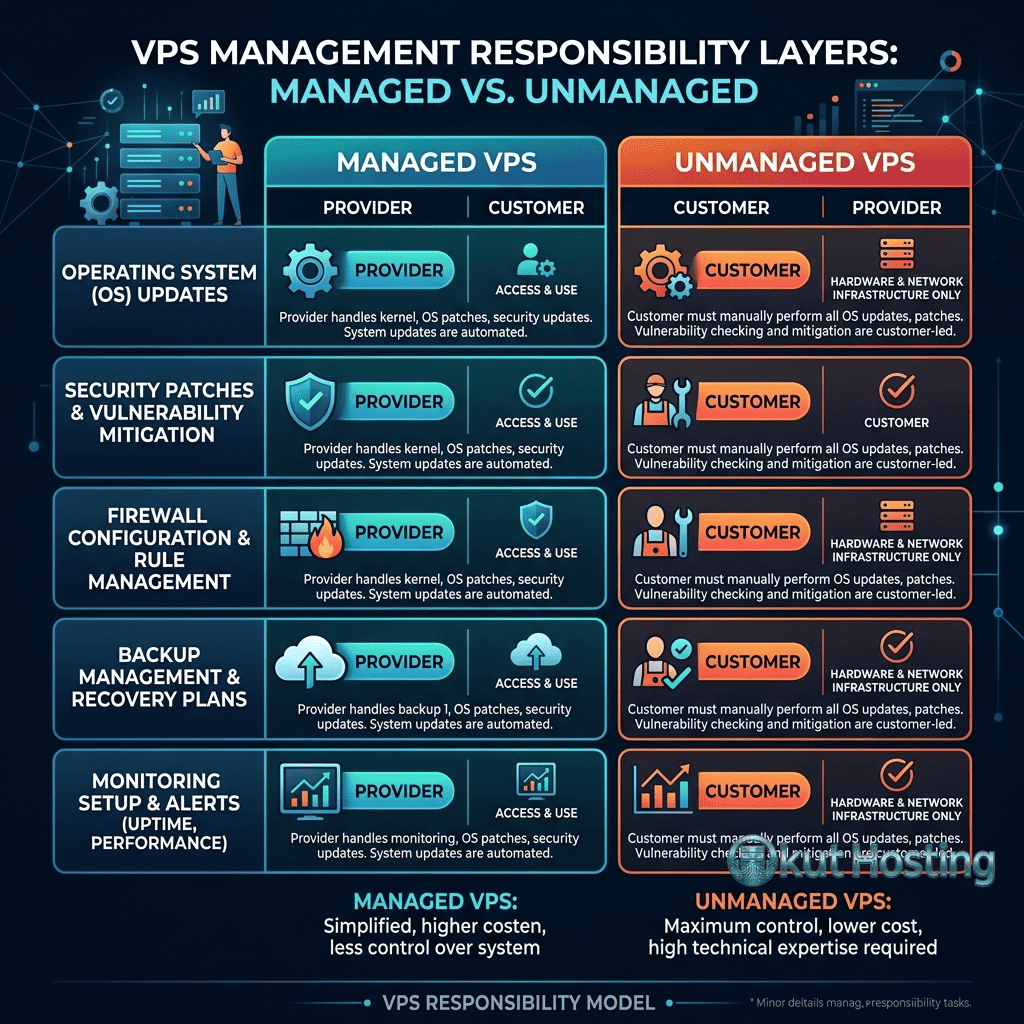
Responsibility Comparison
The fundamental difference between managed and unmanaged VPS is the division of administrative responsibilities. In unmanaged hosting, the customer is responsible for: operating system updates and security patches; web server installation and configuration (Nginx, Apache); database server installation and optimization (MySQL, PostgreSQL); PHP runtime configuration and optimization; SSL certificate installation and renewal; firewall configuration and maintenance; intrusion detection and prevention; backup configuration and management; performance monitoring and optimization; and troubleshooting application and server issues.
In managed hosting, the hosting provider handles most or all of these responsibilities, with the customer responsible only for website content, application code, and business-level decisions. This dramatic reduction in administrative responsibility enables non-technical users to operate VPS hosting without system administration skills, while freeing technical users from routine maintenance tasks that consume time better spent on development and business activities.
Pricing Comparison
Unmanaged VPS pricing reflects the cost of infrastructure only. Entry-level unmanaged VPS instances from DigitalOcean, Linode, and Vultr start at $4-6/month for small instances with 1 vCPU, 1 GB RAM, and 25 GB storage. Mid-range instances with 4 vCPUs, 8 GB RAM, and 160 GB storage typically cost $40-50/month. The pricing is transparent and predictable, with no additional fees for management services.
Managed VPS pricing includes both infrastructure costs and management service fees. Managed VPS plans from providers like Cloudways, SiteGround Cloud, and InMotion Hosting typically cost 2-4x more than equivalent unmanaged infrastructure. A managed VPS with specifications comparable to a $40/month unmanaged VPS might cost $80-160/month depending on the provider and management scope. The price premium pays for the professional server administration, monitoring, security management, and support services included with managed hosting.
The total cost comparison should consider not just the hosting price but the value of time spent on server administration. For businesses where the server administrator’s time has significant opportunity cost, managed hosting may be more cost-effective despite higher hosting fees. For individuals and organizations with available technical expertise and time for server management, unmanaged hosting provides significant cost savings.
Security Comparison
Security implementation differs significantly between managed and unmanaged VPS. Managed providers implement security hardening as part of their service: firewall configuration, SSH hardening, automatic security updates, malware scanning, intrusion detection, and DDoS mitigation are typically included. The security implementation benefits from the provider’s expertise and established security practices applied consistently across their managed server fleet.
Unmanaged VPS security is entirely the customer’s responsibility. While the infrastructure provider ensures network-level security and physical data center security, the operating system and application security depend on the customer’s knowledge and diligence. Properly secured unmanaged VPS can match or exceed managed VPS security, but improperly secured unmanaged VPS is significantly more vulnerable to attacks, malware, and data breaches. The security risk of unmanaged hosting is proportional to the administrator’s security expertise and the consistency of their security maintenance practices.
Performance Optimization
Managed VPS providers typically implement performance optimization as part of their service. This includes web server configuration optimization (Nginx tuning, gzip compression, caching configuration), PHP optimization (OPcache configuration, PHP-FPM pool tuning), database optimization (buffer pool sizing, query cache configuration, slow query identification), and caching layer implementation (Redis, Memcached, Varnish). These optimizations are applied based on the provider’s expertise with the specific server workload type.
Unmanaged VPS performance optimization requires the customer to implement all optimizations manually. While this provides maximum control over every configuration parameter, it requires knowledge of web server tuning, PHP optimization, database performance, and caching strategies. For technically capable administrators, unmanaged VPS provides opportunities for deeper optimization than managed services typically implement. For less experienced administrators, unmanaged VPS may perform suboptimally due to default configurations that are not tuned for the specific workload.
Learning Curve and Skill Requirements
Unmanaged VPS requires proficiency in Linux system administration, command-line operations, web server configuration, database management, networking fundamentals, and security best practices. The learning curve for developing these skills is significant — even experienced developers may lack system administration expertise needed for production server management. Resources for learning include official documentation, community tutorials, video courses, and certifications (Linux+ , RHCSA, AWS certifications).
Managed VPS reduces the skill requirements to application-level knowledge: uploading files, managing content, configuring applications through web interfaces, and communicating requirements to the support team. This lower skill threshold enables non-technical business owners, content creators, and marketing teams to operate VPS-hosted infrastructure without system administration expertise.
Staging and Development Environments
Managed WordPress VPS providers typically include staging environment functionality that enables testing changes, plugin updates, and theme modifications on a copy of the production site before deploying to live. Staging environments reduce the risk of breaking changes impacting the live site. Unmanaged VPS requires manually creating and maintaining staging environments through server cloning, separate virtual hosts, or Docker-based development environments. The managed staging convenience is particularly valuable for WordPress sites where plugin updates and theme changes carry compatibility risk.
WordPress Hosting: Managed vs Unmanaged
WordPress hosting is the most common use case for evaluating managed vs unmanaged VPS. Managed WordPress VPS providers (Cloudways, Kinsta, WP Engine, Flywheel) provide WordPress-specific optimizations including: pre-configured LEMP stack tuned for WordPress; automatic WordPress core, theme, and plugin updates; WordPress-specific security scanning and hardening; staging environments for testing changes before production deployment; automated backup with one-click restoration; CDN integration for content delivery acceleration; and WordPress-specific performance monitoring.
Unmanaged WordPress VPS requires manual installation and configuration of the complete WordPress stack: installing and configuring Nginx or Apache, PHP-FPM, MySQL/MariaDB, Redis, SSL certificates, and WordPress itself. While this approach provides complete control and typically lower costs, it requires significant technical expertise and ongoing maintenance commitment. For WordPress agencies managing many sites, the efficiency of managed WordPress hosting often justifies the price premium. For technically capable individuals hosting one or a few sites, unmanaged VPS provides more control at lower cost.
Support Comparison
Managed VPS support typically includes server administration assistance, troubleshooting, performance optimization help, and proactive monitoring with issue resolution. Support teams have server-level access and can directly implement fixes, configuration changes, and optimizations. This comprehensive support significantly reduces the technical burden on the customer.
Unmanaged VPS support is limited to infrastructure-level issues: server provisioning, network connectivity, hardware availability, and billing. The provider does not assist with operating system configuration, software installation, application troubleshooting, or performance optimization. For server-level issues, the customer must resolve problems independently using documentation, community resources, and personal expertise. This limited support scope requires self-sufficiency in Linux system administration.
Scalability
Both managed and unmanaged VPS support vertical scaling (upgrading to larger instances) and horizontal scaling (adding additional servers). Managed providers often handle scaling operations including load balancer configuration, database replication setup, and multi-server architecture implementation. Unmanaged VPS scaling requires the customer to implement scaling architecture, configure load balancers, manage session sharing, and coordinate database replication independently.
Backup Comparison
Managed VPS providers typically include automated backup services with daily or more frequent backup schedules, off-server backup storage, and one-click restoration interfaces. Backup management — including monitoring backup success, testing restoration procedures, and managing retention policies — is handled by the provider as part of the managed service scope. This comprehensive backup management provides reliable data protection without customer involvement.
Unmanaged VPS backup is entirely the customer’s responsibility. While cloud platforms provide snapshot functionality and optional backup services, configuring comprehensive backup strategies (implementing the 3-2-1 rule, setting up offsite backup, automating database backup, testing restoration procedures) requires technical knowledge and ongoing maintenance. The risk of inadequate backup protection is significant with unmanaged VPS, as many less experienced administrators neglect proper backup implementation until data loss occurs.
Migration Considerations
Migrating between managed and unmanaged VPS requires careful planning. Moving from managed to unmanaged requires assuming all administrative responsibilities previously handled by the provider. The transition should include: documenting current server configuration; establishing security hardening procedures; implementing monitoring and backup systems; and building internal expertise for ongoing maintenance. Moving from unmanaged to managed may require adapting custom configurations to the managed provider’s supported environment, potentially limiting flexibility but gaining professional administration.
Compliance and Regulatory Impact
For organizations subject to compliance requirements (PCI DSS, HIPAA, SOC 2, GDPR), managed VPS providers can simplify compliance by implementing required security controls, maintaining audit trails, and providing compliance documentation. Managed providers experienced with regulated workloads understand the specific security configurations, access controls, and monitoring requirements mandated by compliance frameworks. Achieving equivalent compliance on unmanaged VPS requires implementing these controls independently, which demands compliance expertise beyond standard system administration skills.
E-Commerce Hosting Considerations
E-commerce platforms (WooCommerce, Magento, PrestaShop) benefit significantly from managed hosting due to the security sensitivity of payment processing, the performance impact on conversion rates, and the business continuity requirements of online stores. Managed e-commerce VPS provides PCI-compliant server configuration, optimized database performance for product catalog and order processing, SSL management for secure transactions, and 24/7 monitoring that prevents revenue-impacting outages.
Monitoring Differences
Managed VPS includes proactive monitoring where the provider monitors server health, performance metrics, and security events, responding to issues before they impact application availability. This monitoring operates continuously and includes automated alerting with human response during critical events. Unmanaged VPS monitoring must be implemented by the customer using tools like Netdata, Prometheus/Grafana, or external monitoring services. Without proactive monitoring, issues on unmanaged VPS may go undetected until users report problems or the server becomes inaccessible.
Control and Flexibility
Unmanaged VPS provides complete root access and full control over every aspect of the server environment. Any software can be installed, any configuration can be modified, and any technology stack can be deployed. This flexibility enables custom configurations, experimental setups, and non-standard deployments that managed providers may not support.
Managed VPS may restrict certain server modifications to maintain the managed environment’s stability and the provider’s ability to support it. Some managed providers limit root access, restrict software installation to approved applications, or prevent configuration changes that could conflict with managed service operations. The trade-off between control and management convenience is a fundamental consideration in the managed vs unmanaged decision.
Provider Options
Major Unmanaged VPS Providers
DigitalOcean, Linode (Akamai), Vultr, Hetzner, Contabo, OVHcloud, UpCloud, Kamatera, and Oracle Cloud provide unmanaged VPS hosting with varying pricing, performance, and data center coverage. These providers compete primarily on infrastructure quality, pricing, and developer experience.
Major Managed VPS Providers
Cloudways, Kinsta, WP Engine, SiteGround Cloud, InMotion Hosting, Liquid Web, A2 Hosting, and Nexcess provide managed VPS hosting with varying management scope, WordPress-specific features, and pricing tiers. These providers compete primarily on management quality, support responsiveness, and application-specific optimization.
Hybrid Approaches
Hybrid approaches combine unmanaged infrastructure with management tools or services. ServerPilot, SpinupWP, GridPane, and RunCloud provide server management panels that automate common administration tasks on unmanaged VPS instances. These tools provide automated security updates, web server configuration, SSL management, and WordPress deployment — bridging the gap between fully unmanaged and fully managed hosting. The hybrid approach provides more control than managed hosting and less administrative burden than fully unmanaged hosting, often at intermediate pricing.
Total Cost of Ownership Analysis
True cost comparison between managed and unmanaged VPS must account for all costs, not just hosting fees. Unmanaged VPS total costs include: hosting infrastructure fees; management tool licensing (cPanel, Plesk); monitoring service subscriptions; backup storage costs; and the administrator’s time for setup, maintenance, security, updates, and troubleshooting. Managed VPS total costs include: the managed hosting fee (which bundles infrastructure, management, monitoring, backup, and support). When the administrator’s time is valued appropriately, managed hosting frequently proves more cost-effective for businesses where server administration is not a core function.
Decision Framework
Choose managed VPS if: server administration is not a core competency; time is better spent on business activities than server management; budget accommodates the management premium; WordPress-specific optimizations are valuable; and comprehensive support is important for business continuity.
Choose unmanaged VPS if: Linux system administration skills are available; cost optimization is a primary priority; full control over server configuration is required; custom software stacks or non-standard configurations are needed; and the organization can handle security and maintenance independently.
Summary
The managed vs unmanaged VPS decision balances technical control, administrative responsibility, cost, and support requirements. Managed VPS provides convenience, professional administration, and comprehensive support at a premium price. Unmanaged VPS provides maximum control, lower costs, and complete flexibility with full administrative responsibility. Neither option is inherently superior — the appropriate choice depends on the organization’s technical capabilities, time availability, budget constraints, and specific hosting requirements. Understanding these trade-offs ensures that the selected service tier aligns with actual operational needs rather than defaulting to either extreme.
Service features and pricing discussed in this guide reflect information available at the time of writing. Please verify current details on the respective provider websites. Okut Hosting is an independent review platform providing educational hosting content.
For related guides, see our VPS management tools guide, our cloud backup strategies guide, and our cloud server scaling guide.