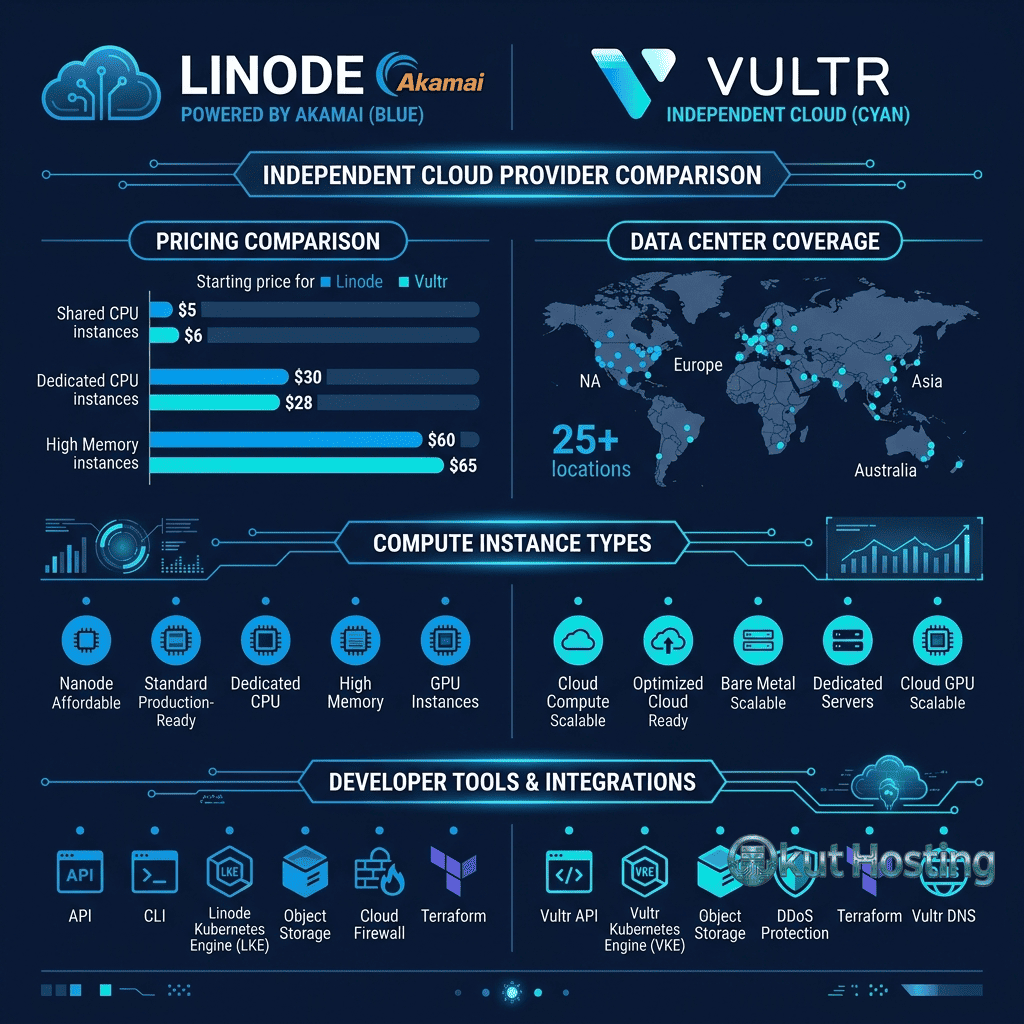
Linode (now part of Akamai Connected Cloud) and Vultr represent two of the most popular independent cloud platforms for developers and businesses seeking alternatives to hyperscale providers. Both offer cloud compute instances, managed databases, block storage, and Kubernetes services with transparent pricing and developer-friendly management tools. However, meaningful differences in infrastructure coverage, service portfolios, performance characteristics, and pricing details influence which platform better serves specific hosting requirements. This comprehensive comparison examines both platforms across every significant dimension to help hosting buyers make informed, data-driven decisions.
The comparison evaluates both platforms as of current offerings, recognizing that Linode’s integration into Akamai Connected Cloud has expanded its capabilities beyond the original Linode platform. The analysis maintains neutrality, presenting factual differences without recommending one platform over the other.
Company Background and Ownership
Linode was founded in 2003 as one of the original cloud hosting pioneers, providing Linux-based virtual servers before “cloud computing” became a mainstream term. In 2022, Akamai Technologies acquired Linode for approximately $900 million, integrating Linode’s cloud compute infrastructure with Akamai’s global CDN and security platform. The acquisition has expanded Linode’s capabilities through Akamai’s edge computing, DDoS protection, and content delivery infrastructure.
Vultr was founded in 2014 by Constant Contact founder David Auerbach, entering the cloud hosting market with a focus on global data center coverage and competitive pricing. Vultr has grown organically without acquisition, maintaining independent operations and expanding its data center network to over 30 locations across six continents. Vultr’s operational independence provides agility in service development and pricing decisions.
Pricing Comparison
Both platforms implement hourly billing with monthly caps and offer comparable entry-level pricing. The most popular plan tiers are priced similarly, with minor differences across specific configurations. Vultr’s pricing includes slightly different resource allocations at certain price points, while Linode’s pricing benefits from Akamai integration features included at no additional cost.
For equivalent compute resources, pricing is competitive between the two platforms. Differences emerge in specific areas: Vultr’s High Frequency Compute instances provide premium NVMe-based performance at higher price points, while Linode’s Dedicated CPU plans provide guaranteed processing power for performance-sensitive workloads. Both platforms offer transparent pricing without hidden fees, usage-based surcharges, or complex pricing calculators.
Bandwidth allowances differ between platforms. Linode includes generous bandwidth with monthly transfer pools shared across instances within an account. Vultr provides per-instance bandwidth allocations. The practical impact depends on whether bandwidth usage is concentrated on specific instances or distributed across multiple instances.
Data Center Coverage
Vultr operates data centers in over 30 locations across six continents — the most extensive geographic coverage among independent cloud providers. Locations span North America, South America, Europe, Asia-Pacific, Africa, and Oceania, providing data center proximity for virtually any global audience. This geographic breadth is Vultr’s most significant differentiator over Linode and most competing platforms.
Linode operates data centers in 11 global locations across North America, Europe, and Asia-Pacific. While less extensive than Vultr’s coverage, Linode’s locations cover major hosting regions. The Akamai acquisition provides access to Akamai’s extensive edge network for CDN and security services, extending Linode’s effective global reach beyond its core data center locations. For workloads that benefit from CDN acceleration, the Akamai edge network provides global presence that complements Linode’s core compute locations.
Compute Instance Types
Linode offers Shared CPU (Nanode, Standard), Dedicated CPU, High Memory, GPU, and Premium plans. Shared CPU plans provide cost-effective compute for general workloads. Dedicated CPU plans provide guaranteed processing power. High Memory plans provide optimized memory-to-CPU ratios for database and caching workloads. GPU plans provide NVIDIA GPU instances for machine learning and GPU computing. Premium plans use the latest AMD EPYC processors with increased network bandwidth.
Vultr offers Cloud Compute (shared vCPU), High Frequency (NVMe, higher clock speed), High Performance (dedicated vCPU), and Bare Metal servers. High Frequency instances provide consistently higher clock speeds and NVMe storage for performance-sensitive workloads. Bare Metal servers provide dedicated physical servers with cloud management interfaces. GPU instances are available for ML/AI workloads.
Managed Kubernetes
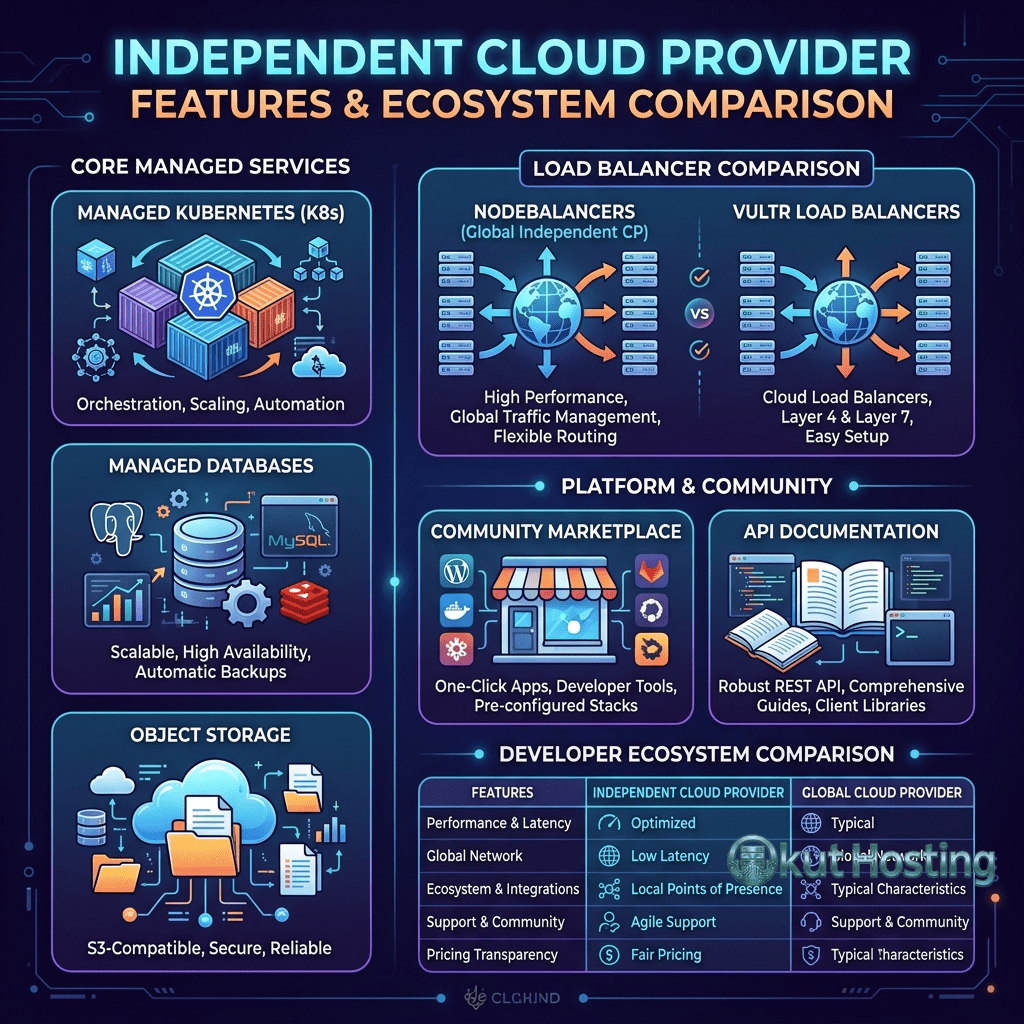
Both platforms provide managed Kubernetes services. Linode Kubernetes Engine (LKE) provides managed Kubernetes clusters with free control plane, automatic upgrades, and integration with Linode’s storage and networking services. Vultr Kubernetes Engine (VKE) provides similar managed Kubernetes with free control plane management. Both services support standard Kubernetes APIs, kubectl management, and helm chart deployment.
The practical differences between LKE and VKE are minimal for most Kubernetes workloads. Both provide production-capable managed Kubernetes with automated control plane management. The choice between them typically follows the broader platform decision rather than Kubernetes-specific differences.
Managed Databases
Linode Managed Databases support MySQL, PostgreSQL, Redis, and MongoDB with automated backups, high availability, and maintenance management. Vultr Managed Databases support MySQL, PostgreSQL, Redis, Kafka, Valkey, and Caching (Memcached/Redis) with similar managed features. Both platforms provide production-ready database hosting that eliminates database server administration.
Vultr’s managed database portfolio includes Kafka for event streaming, which Linode does not currently offer. Linode’s MongoDB support provides document database hosting not available on Vultr’s managed database platform. The database engine selection may influence platform choice for workloads with specific database technology requirements.
Block and Object Storage
Both platforms provide block storage volumes for persistent server storage and S3-compatible object storage for unstructured data. Linode Block Storage provides SSD-based volumes attachable to compute instances. Vultr Block Storage provides similar capabilities with NVMe-based performance on High Frequency instances. Object Storage pricing and performance are comparable between platforms.
Networking Features
Both platforms provide VPC (Virtual Private Cloud) networking, firewalls, load balancers, and DNS management. Linode VLAN networking provides Layer 2 private networking between instances. Vultr VPC 2.0 provides similar private networking capabilities. Both platforms support IPv4 and IPv6 addressing.
Linode’s Akamai integration provides access to Akamai’s CDN and Cloud Firewall services. Vultr provides native DDoS protection and integrated DNS services. The networking feature sets are comparable for most use cases, with Akamai integration providing Linode an advantage for CDN-intensive workloads.
Developer Tools and API
Both platforms provide comprehensive REST APIs, CLI tools, Terraform providers, and Ansible integration. Linode’s API and CLI (linode-cli) provide full platform management. Vultr’s API and CLI (vultr-cli) provide equivalent capabilities. Both platforms support cloud-init for automated server provisioning. The developer tool ecosystems are functionally equivalent, with both supporting modern IaC and DevOps workflows.
Community and ecosystem size differ slightly. Linode has a longer market presence (since 2003) with an established community, extensive documentation, and active forums. Vultr’s community, while newer, is growing and benefits from the platform’s broader data center appeal.
Marketplace and Application Images
Both platforms provide marketplace images for one-click deployment of popular applications. Linode Marketplace includes WordPress, LAMP, Docker, GitLab, Minecraft, and numerous other applications. Vultr Marketplace provides similar one-click deployments with comparable application coverage. Both platforms support custom ISO uploads and server image creation for custom deployment workflows.
Edge Computing and CDN
Linode’s Akamai integration provides a significant advantage in edge computing and content delivery. Akamai operates one of the world’s largest CDN networks with thousands of edge locations globally. Linode customers can leverage this CDN infrastructure for content delivery acceleration, edge computing workloads, and global traffic management. This edge computing capability is unique among independent cloud providers and positions Linode as a hybrid between traditional cloud compute and edge delivery platforms.
Vultr does not offer integrated CDN services, though Vultr’s extensive data center network (30+ locations) provides an alternative approach to geographic proximity. Users can deploy instances in multiple Vultr data centers to serve different geographic regions directly rather than through CDN edge caching. This approach provides more control but requires more complex infrastructure management.
Bare Metal Servers
Vultr provides Bare Metal server options that offer dedicated physical servers with cloud management interfaces. Bare Metal instances deliver the full performance of dedicated hardware without virtualization overhead, suitable for high-performance workloads that need maximum I/O performance, specific hardware configurations, or compliance requirements that mandate physical server isolation. Linode does not currently offer bare metal servers, which may be a factor for workloads requiring dedicated hardware.
Billing and Cost Management
Both platforms provide detailed billing dashboards with usage tracking and cost breakdowns. Linode offers transfer pooling where bandwidth allowances from multiple instances are combined into a shared pool, reducing the risk of bandwidth overage on individual high-traffic instances. Vultr allocates bandwidth per instance, which may result in unused bandwidth on low-traffic instances while high-traffic instances approach their limits.
Linode also provides promotional credits and referral programs that can offset hosting costs. Vultr offers similar promotional programs. Both platforms bill in USD with international payment support including credit cards and PayPal.
Monitoring and Alerting
Both platforms provide built-in monitoring for compute instances including CPU, memory, disk, and network metrics. Linode’s monitoring integrates with Akamai’s observability tools, providing more comprehensive visibility into infrastructure performance. Vultr provides instance-level monitoring through the management console. Both platforms support integration with third-party monitoring solutions (Datadog, Prometheus, Grafana) for organizations that need more comprehensive monitoring and alerting capabilities beyond built-in platform monitoring.
Auto-Scaling and Load Balancing
Both platforms provide managed NodeBalancer (Linode) and Load Balancer (Vultr) services for traffic distribution across multiple instances. Neither platform provides fully automated auto-scaling out of the box, but both support API-driven infrastructure management that enables building custom auto-scaling workflows using external tools, scripts, or orchestration platforms. For organizations requiring automated scaling based on traffic or resource utilization metrics, custom auto-scaling implementations using the platform APIs and monitoring data provide the necessary functionality.
DDoS Protection
Linode benefits from Akamai’s enterprise-grade DDoS mitigation infrastructure, which provides comprehensive volumetric and application-layer attack protection. This DDoS protection is significantly more capable than what standalone cloud providers typically offer. Vultr provides DDoS protection through its own network infrastructure, with protection capabilities that cover common attack vectors. For workloads that face significant DDoS risk, Linode’s Akamai integration provides a meaningful security advantage.
WordPress Hosting Comparison
WordPress performance on both platforms is competitive when instances are properly configured with optimized LEMP stacks. Vultr’s High Frequency instances provide storage I/O performance advantages for database-intensive WordPress workloads. Linode’s Akamai CDN integration provides content delivery acceleration advantages for geographically distributed WordPress audiences. The optimal platform for WordPress hosting depends on whether storage performance or CDN integration is more important for the specific deployment.
Backup and Recovery
Both platforms provide automated backup services with daily backups and configurable retention. Linode backups are priced as a percentage of instance cost. Vultr backups follow similar pricing models. Both support manual snapshots for point-in-time recovery. The backup capabilities are functionally equivalent between platforms.
Support Comparison
Both platforms provide 24/7 customer support through ticket systems. Linode’s community support includes extensive documentation, community Q&A, and developer tutorials. Vultr’s support includes documentation and community resources. Both platforms provide responsive support for platform-specific issues. The support experiences are comparable, with both receiving generally positive reviews for responsiveness and technical competence.
Performance Benchmarks
Independent performance benchmarks from third-party reviewers generally show competitive performance between both platforms for standard compute workloads. Vultr’s High Frequency instances typically show advantages in storage I/O benchmarks due to NVMe storage and higher clock speeds. Linode’s Premium instances show competitive CPU performance with AMD EPYC processors. Network performance is comparable between platforms across equivalent data center locations.
Compliance and Security
Both platforms maintain SOC 2 Type II compliance and implement infrastructure security including DDoS mitigation, network security, and physical data center security. Linode’s Akamai integration provides access to enterprise-grade security services including Cloud Firewall and DDoS protection. Both platforms comply with GDPR for European data handling. The compliance portfolios are adequate for most standard cloud workloads.
Uptime and Reliability
Both platforms provide uptime SLAs with service credit compensation for downtime. Historical uptime data from independent monitoring services shows both platforms maintaining strong availability records. Infrastructure redundancy including redundant power, networking, and storage provides resilience against component failures at both providers. For mission-critical workloads, multi-instance architectures with load balancing provide application-level availability beyond single-server SLA guarantees on either platform.
Migration Between Platforms
Migrating between Linode and Vultr follows standard server migration procedures including server configuration replication, data transfer, database migration, and DNS reconfiguration. Both platforms support Terraform, enabling Infrastructure as Code-based migration where infrastructure configurations defined in Terraform can be redeployed on the target platform by changing the provider configuration. This IaC-based migration approach reduces migration complexity and ensures configuration consistency during platform transitions.
WooCommerce and E-Commerce Hosting
E-commerce workloads benefit from both platforms but with different strengths. Vultr’s High Frequency instances provide storage I/O performance advantages that benefit database-intensive e-commerce operations including product catalog queries, order processing, and inventory management. Linode’s Akamai CDN integration provides content delivery advantages for e-commerce sites with geographically distributed customers, accelerating product image delivery and static asset loading.
For WooCommerce specifically, both platforms support optimized LEMP stack configurations with MySQL/MariaDB, PHP-FPM, and Nginx. Redis caching integration improves dynamic page caching performance on both platforms. The choice between platforms for WooCommerce hosting depends on whether storage I/O performance or CDN integration provides more value for the specific store’s traffic patterns and geographic distribution.
Community and Documentation
Linode’s community has been established since 2003, providing extensive documentation, community Q&A forums, developer tutorials, video guides, and an active user community. The documentation quality is consistently praised for clarity and depth. Vultr’s community and documentation are growing but newer, with comprehensive API documentation and increasing tutorial coverage. For users who rely heavily on community resources and documentation for learning and troubleshooting, Linode’s more mature community provides an advantage.
Decision Framework
To simplify the platform selection decision, consider these priority-based guidelines: Choose Vultr if geographic data center coverage is the primary requirement, if bare metal servers are needed, or if specific regional proximity (Africa, South America) is essential. Choose Linode if CDN integration and edge computing are important, if transfer pooling bandwidth management is valuable, or if community maturity and documentation depth influence the decision. Choose either platform if general cloud hosting without strong geographic or CDN requirements is the primary need, as both deliver excellent value and comparable features for standard cloud workloads.
Summary
Linode and Vultr are both excellent independent cloud platforms that provide competitive alternatives to hyperscale providers at transparent pricing. The key differentiators are: Vultr provides superior data center coverage (30+ locations vs 11), making it the better choice for workloads requiring specific geographic proximity. Linode provides Akamai integration advantages for CDN, edge computing, and enterprise security. Pricing is competitive between platforms with minor differences at specific plan tiers. Both platforms deliver comparable performance, managed services, and developer tools.
For hosting buyers choosing between Linode and Vultr, the decision often comes down to geographic requirements (Vultr advantage), CDN and edge computing needs (Linode/Akamai advantage), and specific managed database requirements. For general cloud hosting without strong geographic or CDN requirements, both platforms provide excellent value and either represents a sound hosting choice.
Features, pricing, and availability discussed in this comparison reflect information available at the time of writing. Please verify current details on the official Linode and Vultr websites. Okut Hosting is an independent review platform with no affiliate relationships with any hosting company mentioned in this article.
For related reviews, see our DigitalOcean vs Linode comparison, our Vultr VPS review, and our guide to cloud server scaling.